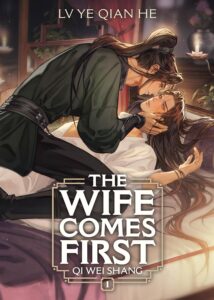
The Wife Comes First
by Lv Ye Qian He
Genres: Fantasy, Light NovelsPages: 396
Series: The Wife Comes First #1
Rating:

Synopsis:As his life flashes before his eyes, self-obsessed Prince Cheng has a moment to reflect on something curious. Despite knocking at death’s door, only one person remains by his side: his all-but-abandoned prince-consort, Mu Hanzhang. Except, rather than celebrate that fact, Prince Cheng can only wonder… Why, after everything, is Mu Hanzhang still with him?
After all, Prince Cheng spent most of his life philandering and mastering political intrigue. Meanwhile, Mu Hanzhang had to discard his dreams of taking the Imperial Examination to become a minister, and was instead coerced to serve as male wife to a cruel prince!
Granted a second chance, Prince Cheng is miraculously reborn, waking up the morning after his wedding. As he does, the prince makes another vow: the wife comes first, the state second, and the husband last.
Where to start? Well first, he must kneel outside Mu Hanzhang’s bedroom door and beg to be let in, of course! Then again, after the sacrifices Mu Hanzhang’s had to make, will he even be willing to forgive his new husband?
I hadn’t heard much about Lv Ye Qian He’s The Wife Comes First before picking up volume one, but I was quickly hooked by the concept: it opens with Jing Shao’s death, with the body of his neglected but loyal first wife (his only male wife, Mu Hanzhang) in his arms, and then his awakening beside that same wife on their wedding night.
It starts in a bit of an uncomfortable place, truth be told: the wedding night didn’t actually go well, and Jing Shao injured Mu Hanzhang pretty badly. It’s not entirely clear how consensual that all was from the narrative: Mu Hanzhang doesn’t consider that he can say no, while Jing Shao was drunk… but I will say that in the rest of the novel, when Mu Hanzhang shows reluctance or says no, Jing Shao listens and does only what Mu Hanzhang is comfortable with (albeit maybe with a bit of pleading and cajoling). It’s all a bit difficult because of the setting: both of them were forced into the marriage, and it’s unclear how far either of them would’ve been able to meaningfully consent in the circumstances.
Personally, my read was that Mu Hanzhang would’ve been unlikely to give an outright no, and Jing Shao would likely have heeded it if he had — but it is ambiguous because it happens off-screen, and Jing Shao’s behaviour in hurting Mu Hanzhang (though later shown to be due to ignorance, at least in part) isn’t great, so keep all that in mind.
I would also note that there is some significant violence against women, largely off-screen, including Mu Hanzhang ordering for someone to be beaten to death for betraying him and Jing Shao. It isn’t treated as horrifying, just completely matter-of-fact — it’s almost easy to miss for how unremarkable it is. Most of the female characters are scheming and/or nasty, aside from one of Jing Shao’s servants (who works to protect Mu Hanzhang from the empress’ scheming) and Mu Hanzhang’s mother. Part of that is pretty much compelled by the plot: if only Mu Hanzhang stood by Jing Shao at the end, his other wives/concubines necessarily couldn’t stick by him… but it isn’t great.
That said, a lot of the rest is really sweet, and I actually really enjoyed it — for the number of words I’ve spent explaining these factors, they’re background to the story rather than the most prominent thing. Jing Shao quickly becomes fascinated with Mu Hanzhang, who is more reserved but quickly begins to have feelings for his husband as well, regardless of his fears around sex. The whole concept of “gentleman wives” (mandatory for the younger sons in certain families) and their gatherings is a nice touch, rather than just having Mu Hanzhang be some kind of exception. I also enjoyed that Jing Shao actually cares deeply about his elder brother, and we see their relationship grow as a result of his understanding (from his past life) that his brother cares for him.
Soo… overall, I enjoyed the relationship development and the court intrigue (and Mu Hanzhang’s scheming mind), and ended up flying through the book. I’m very curious to see how their relationship develops, and how the two of them manage to avoid the bad outcome that we see at the start, especially since Mu Hanzhang knows nothing about it (as least as far as we know, and the third person limited narrative seems to confirm that: Jing Shao is presumably the only one who got the “do-over”).
Rating: 4/5 (“really liked it”)

I completely agree with you. I also really enjoyed Jing Shao’s genuine love for his brother and the relationship between Jing Shao and Mu Hanzhang (in the do-over anyway). The misogyny bugged me a lot – they could have had (even just some of) the concubines not ‘stick by’ Jing Shao’s side for perfectly reasonable self-preservation, acknowledging their oppressed position in society and lack of any kind of emotional connection with Jing Shao etc. and made them complex and understandable characters, if not as ‘virtuous’ as Mu Hanzhang. You could still have one of two really ‘evil’/mean women, just have some variety at least. This would allow Mu Hanzhang to still be seen as the best, most loyal (and therefore make JS so dedicated to him in life 2.0) without making all the female characters childish and evil. Some internalised misogyny that needs unpacking!
Keira @Keira’s Bookmark recently posted…July Book Haul
I don’t think the author’s subtle enough for that, to be honest, because they want to set up Jing Shao as being solely faithful to Mu Hanzhang in his second life. Jing Shao has to have had concubines already because of the setting and his status, so the author’s problem is getting rid of them as rivals to Mu Hanzhang. If there were any that Jing Shao felt positively about at all, the author would see it as a much harder job convincing anyone that he wouldn’t have continued having sex with them (especially while Mu Hanzhang isn’t interested). In the setting, his devotion to a single wife is exceptional, so the author tries to make it “believable”.
I can see how it could’ve been done — e.g. Jing Shao having a concubine he didn’t actually have sex with before for some reason, like an older woman given to him as a gift from a brother or the emperor for her skills managing the household (…and maybe, they hope, keeping Jing Shao in line), for example. Or a concubine who has become sick, or heck, whom he just doesn’t have chemistry with. Buuut given the author’s lack of subtlety, I think they wouldn’t have dared introduce a potential rival to Junqing, because I don’t think their writing quality could stand up to it.
But like you say, part of the author’s problem comes out of internalised misogyny blinkering them to the options — and homophobia too. There’s almost certainly a bit of “why would Jing Shao have sex with Mu Hanzhang when there’s literally any other decent woman around he could be sleeping with instead? ah, okay, we must make Mu Hanzhang the most devoted and allow for no potential rivals at all”. Ge Ruoyi gets to be pretty awesome (mostly off-screen) because she’s crucial to Jing Shao’s plans of doing better in his second life, and we know he’s going to send her away on a secret mission, so she doesn’t have the same plot hobbles to prevent her being a threat to Junqing (though sadly we see comparatively little of her, we do get a bit in the second book).
I sound so harsh! But I enjoy this series for what it is… accepting from the outset that it has a bunch of flaws and one of them is simply the author’s ability. I suppose what some people might call a “guilty pleasure” or “popcorn read” or whatever.
(Also wow I have so much to say about this series. But sometimes something that’s flawed but enjoyable offers that scope for lots of discussion.)