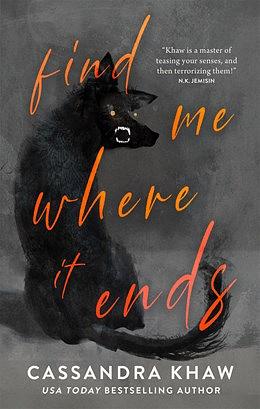
Find Me Where It Ends
by Cassandra Khaw
Genres: FantasyPages: 128
Rating:

Synopsis:Antigone can see death coming. It always takes the form of a black dog, nipping at the heels of the soon-to-be-departed.
When Antigone's own black dog appears on her doorstep, she isn't frightened. In fact, she welcomes her death inside, and it quickly becomes her closest companion. Having death at her side is almost a comfort. But it also forces Antigone to reckon with the life she's lived.
Sometimes we live best when we're dying.
I received a copy of this book for free in exchange for an honest review. This does not affect my opinion of the book or the content of my review.
It’s tough for me to review Cassandra Khaw’s Find Me Where It Ends, because the novella as a whole is probably something I shouldn’t have read. You might think that this is all a pretty obvious metaphor about suicide: someone knows they’re going to die at some point in the next few days, months or years because they met their black dog, and then they invite that dog in and pet it, welcoming it into their life.
Well… yeah, but also, it’s not a metaphor: the whole book is just plain about suicide, and the metaphor is honestly the least of it. I’m going to have to discuss suicide and mental health a bunch of times in this review in order to grapple with the novel, and though I’m trying to be fairly matter-of-fact, I’d say if you have any triggers around that… maybe you’d better not read my review, either.
So… let’s get into it. Antigone is the main character, and she meets her black dog. She knows it means she’s going to die because that always happens to women of her family: okay so far. Problem is, the dog doesn’t mean “you’re going to die tomorrow” or “you’re going to die within two weeks”. It just means “you’re going to die” — and in Antigone’s case she has conflicting information from divination, which let her know long ago that she would have a long life (though, perhaps crucially, she stopped the process of investigation before learning what would kill her).
However, she treats the arrival of her dog as a sign of absolutely impending doom, despite those two pieces of information and that… does and doesn’t make sense to me. It’s not very logical, which is why it doesn’t totally make sense. But in another sense, it’s familiar: I have anxiety, sometimes quite serious anxiety, and I can easily imagine (don’t really have to imagine) getting this one signal of death, weighing it against knowing myself to be healthy, and deciding I’m going to die and getting terrified. In this situation, I can definitely imagine myself taking the arrival of my black dog as being a sign that I was developing some long, slow, horrible illness that would lead to my death in many years after a lot of misery.
So… while I initially felt like the setup didn’t quite work for me, on reflection it does make a lot of sense. When it comes to anxiety/depression, rationality doesn’t help (at least, not without a lot of work in helping yourself apply it), because it feels less true. It might be pretty fair to say this novel is not only about suicide or depression, but also about anxiety.
The novel turns over the thought of suicide in a few ways: Antigone’s mother saw her black dog and immediately decided to commit suicide, and after the arrival of her dog, Antigone deals with a woman who is haunted by the ghost of her abusive mother, locked into a horrible cycle with her. When that woman refuses to let Antigone exorcise the ghost and then ends up killing herself, her daughter says that if her own mother comes back to haunt her, she’ll kill herself. And then, of course, Antigone decides to kill herself, held back only by a promise to a friend to try to live a few days more.
Like I said, it’s not a metaphor. The suicide part is text, and it’s throughout the whole story. The tension in the book becomes about whether Antigone will choose to live or not, with the friends and family around her reacting (sometimes in unhelpful ways) to her despair.
Thinking it over now at a distance of a few days, I think it’s well done and well written. I think the feelings Antigone has make a lot of sense, and the glimmer of hope at the end feels earned and real, if fragile. I’m still not sure I should personally have read it, because while my reactions to my fear aren’t the same as Antigone’s, the fear of uncertainty is something that strikes deep for me. It was certainly not a comfortable read.
Rating it was a struggle; I normally rate on how much I like a book, but that feels far too complicated with this novella. In the end I settled somewhere between my appreciation for the rumination Khaw’s doing here, and the craft that went into it, and my discomfort with the experience of reading it. I’d have given it 1/5 (“didn’t like it”) right after reading, but it is something that settled a little given time.
Rating: 3/5 (“liked it”)

I just read my first Khaw book, and my gut feeling is that I’m not going to love everything they write, but that they’re never going to write something boring. How was the prose in this book? The one I read had such beautiful writing – and so many words I don’t normally encounter – and I’m hoping that’s a through-line in their work
Cosmic recently posted…Novella Readathon #25: Murder by Memory
Not sure which one you read; I’d say this one is less deliberately… ornamental? than some of her work, so that I was less focused on the prose.
I still want to read this, but it might also be my last Cassandra Khaw book if it doesn’t work out. All the author’s books have fallen in the 2-3 star range for me so far. This definitely sounds like a struggle, but I can appreciate a book that you feel better about after giving it some time to settle.
I’ve found when I liked Khaw’s books I liked them quite a lot, but they’re a bit hit and miss. This one was… perhaps the most accessible, prose-wise? But the topic is heavy.