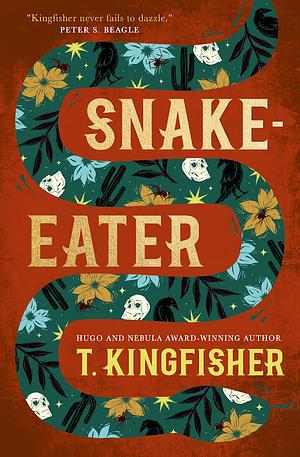
Snake-eater
by T. Kingfisher
Genres: Fantasy, HorrorPages: 352
Rating:

Synopsis:In an isolated desert town, a young woman seeking a fresh start is confronted by ancient gods, malevolent supernatural forces, and eccentric neighbours. A witty horror-tinged fantasy, perfect for fans of Silvia Moreno-Garcia, Chuck Tingle, and Rachel Harrison.
When Selena travels to the remote desert town of Quartz Creek in search of her estranged Aunt Amelia, she is desperate and short of options. Fleeing an unhappy marriage, she has exactly twenty-seven dollars to her name, and her only friend in the world is her dog, Copper.
On arrival, Selena learns Amelia is dead. But the inhabitants of Quartz Creek are only too happy to have a new resident. Out of money and ideas, Selena sees no harm staying in her aunt’s lovely house for a few weeks, tending to her garden and enjoying the strange, desolate beauty of the desert. The people are odd, but friendly, and eager to help Selena settle into her new home.
But Quartz Creek’s inhabitants share their town with others, old gods and spirits whose claim to the land long predates their human neighbours. Selena finds herself pursued by disturbing apparitions, visitations that come in the night and seem to want something from her.
Aunt Amelia owed a debt. Now her god has come to collect.
I saw someone describing T. Kingfisher’s Snake-eater as “cosy horror”, and that does make sense to me, weird as it sounds. There’s something very tempting in the life that Selena manages to find for herself, the friends she makes, and the sense of being home that Kingfisher somehow manages to communicate with every word of description (making her acknowledgements section note about returning to high desert areas pretty unsurprising, though I hadn’t known that she was returning to somewhat familiar ground when she moved).
I love the community described as well — Grandma Billy especially, and Father Aguirre, but really all of them. They’re so kind and welcoming, usually without forcing Selena into anything (even if Grandma Billy’s a bit of a forceful personality, she still gives Selena her space).
One thing that might give people pause in reading this is that Selena’s recovering from an abusive relationship, in which her partner (Walter) tried to control her, often doing so by telling her she’s terrible with people, can’t tell when people are uncomfortable or dislike her, etc, or by acting like she’s mentally ill for having emotions and breaking down under the strain of him treating her that way. A couple of reviewers said that she’s “obviously” suffering from autistic burnout, which I can’t speak to; mostly it looked like someone coming out of a terrible relationship that made them doubt themselves, to me.
And then, of course, there’s Snake-eater. That’s a lot cleaner peril than Walter, really: Selena’s aunt was in a relationship with a roadrunner god, who drained her energy and killed her. Now he wants Selena, and when she declines, he’s furious.
I worried that the two relationships would get knitted together the whole way, with some kind of confrontation with both Snake-eater and Walter, or Snake-eater using Walter — or even vice versa. It felt like that would have over-simplified things, and thankfully that’s not how it played out. I liked that the situation with Walter is ultimately resolved in a single chapter, using everything that Selena has learned about her community and her own ability to take care of herself.
I think there are some slight pacing issues with this one, in that it feels like a very slow build and then all of a sudden everything’s come to a head and it’s over… and I hadn’t quite got enough of a sense of building menace from the slow build (if anything, Selena’s growing comfort kind of gives us the opposite, even if she angers Snake-eater and has to deal with that situation). So that’s worth knowing — but even so it’s a book I flew through.
Rating: 4/5 (“really liked it”)