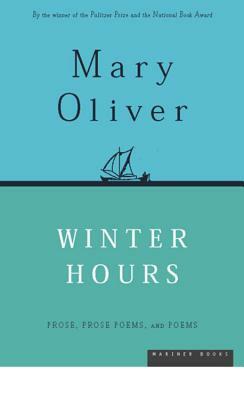
Winter Hours: Prose, Prose Poems and Poems
by Mary Oliver
Genres: Non-fiction, PoetryPages: 109
Rating:

Synopsis:From the winner of the Pulitzer Prize and the National Book Award, her most personal book yet "What good company Mary Oliver is!" the Los Angeles Times has remarked. And never more so than in this extraordinary and engaging gathering of nine essays, accompanied by a brief selection of new prose poems and poems. (One of the essays has been chosen as among the best of the year by THE BEST AMERICAN ESSAYS 1998, another by The Anchor Essay Annual.) With the grace and precision that have won her legions of admirers, Oliver talks here of turtle eggs and housebuilding, of her surprise at an unexpected whistling she hears, of the "thousand unbreakable links between each of us and everything else." She talks of her own poems and of some of her favorite poets: Poe, writing of "our inescapable destiny," Frost and his ability to convey at once that "everything is all right, and everything is not all right," the "unmistakably joyful" Hopkins, and Whitman, seeking through his poetry "the replication of a miracle." And Oliver offers us a glimpse as well of her "private and natural self—something that must in the future be taken into consideration by any who would claim to know me."
After reading a couple of her poetry collections, I was keen to read anything else by Mary Oliver, so I picked up Winter Hours, which is composed of essays and prose poems. It’s a bit of a mixed bag, really; things don’t entirely fit together, though the strength of her writing skill and something of her attitude to the world comes across in each.
Distractingly, though, I can’t tell whether the essay on Edgar Allan Poe is intended to be a serious piece of consideration of his life and work. It seems like it, but then she… makes up something that I’ve absolutely never heard of and can find no reference to anywhere, suggesting that the name “Egaeus” (which she spells “Agaeus”) is close to the word “aegis”, which she defines as a sick note in English schools (in the present tense). That isn’t how you spell the name and that term is not a thing: definitely not in the present, and I can find no evidence that it ever was.
It was weirdly discombobulating and left me feeling out of kilter with the whole book. So… beautifully written, but I’m not sure how seriously to take any of it, and that really changed my enjoyment of it.
Rating: 2/5 (“it was okay”)

That sucks that it threw your whole experience off! If you like prose poetry type stuff the best example I’ve read so far is The White Book by Han Kang!
Keira @Keira’s Bookmark recently posted…[Review] Daggerbound by T. Kingfisher
Yeah, this mostly wasn’t prose-poetry at all, more like essays, with just a couple of poems thrown in. Bit of a weird volume!