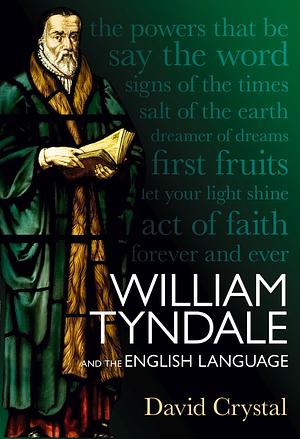
William Tyndale and the English Language
by David Crystal
Genres: History, Linguistics, Non-fictionPages: 242
Rating:

Synopsis:‘Dearly beloved’, ‘say the word’, ‘the powers that be’, ‘for ever and ever’ – these familiar phrases and many more were set down in print for the first time by William Tyndale. For his groundbreaking English translation of the Bible, he deliberately chose to write in a way that could be understood by the widest possible audience.
In the first half of this pioneering exploration of the extraordinary impact Tyndale’s writing had on the development of the English language, David Crystal provides an analysis of his prose style, demonstrating its character as a novel genre of ‘written speech’, and bringing to light the remarkable number of cases where Tyndale is the first recorded user of a word or phrase in English. He also draws attention to the hitherto unrecognised role of Tyndale as an early lexicographer. The second half of the book is a linguistic detective story, devising an innovative lexical and grammatical metric to investigate the often-stated claim that eighty per cent of later biblical translations display Tyndale’s influence.
The result is a fascinating exploration of the work of the Father of the English Bible.
David Crystal’s William Tyndale and the English Language basically wants to examine the premise that William Tyndale had, via the King James Bible, a huge influence on modern English. In aid of that, there’s a lot of analysis of the words and phrases Tyndale uses, and then Crystal works out a way to compare Tyndale’s translations to the King James Bible in order to determine the level of influence.
Apparently there had been past work on this, but Crystal seems to have found this unsatisfying/wanted to put it to the proof, because he tries to reverse engineer the conclusion and then come up with his own ways of making the comparison.
I found the first few chapters quite interesting, but after that I kind of tailed off: the point felt made, and I didn’t have the interest in the point-by-point comparisons, or the dozens-to-hundreds of examples about Tyndale’s language choices in his translations and commentaries.
It’s probably a great read if you’re more into the results of the investigation, but I ran out of stamina for the facts and figures and started skimming once I caught the gist of each chapter.
Rating: 2/5 (“it was okay”)

Leave a Reply