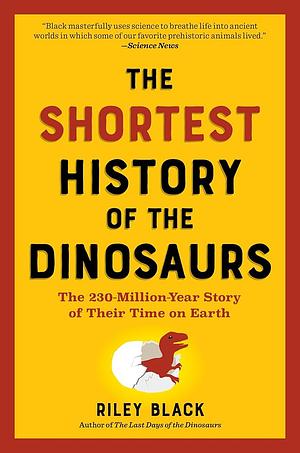
The Shortest History of the Dinosaurs
by Riley Black
Genres: Non-fiction, SciencePages: 236
Rating:

Synopsis:Despite their cultural influence, the grand narrative of the dinosaur story is rarely told. Most of us have heard of Stegosaurus and Tyrannosaurus, for example, but these two dinosaurs lived more than eighty million years apart--a greater span of time than the entire post-T. rex history of the planet. Furthermore, we often know even less about the environments these animals lived in--the other animals and plants inhabiting a dramatic changing Earth alongside the dinosaurs.
The Shortest History of the Dinosaurs tells the full story, a 230-million-year epic of small beginnings, spectacular golden periods, and eventual global domination--before an unthinkable asteroid event brought everything to a screeching halt, covering the major moments in evolution, extinction, and ecology. We learn that, for millions of years in the Triassic, dinosaurs were dog-sized--but slowly developing evolutionary traits like feathers and warm-bloodedness that would set them up for future success. In the Jurassic Period, these traits--and others like laying eggs and growing specialized air sacs--led to an era of rapid growth in dinosaur population and physical size. As Pangea continued to break apart, during the Cretaceous Period, dinosaurs traversed the globe, adapting to air and water--before a six-mile-wide asteroid hit Central America and brought the age of dinosaurs to a fiery end.
Using countless recent fossil discoveries, fresh understandings of genetics and evolution, and over fifty illustrations and maps, author Riley Black reveals the startling relationships dinosaurs shared with each other, the land they lived on, other animal species, and the earth as a whole.
You’d think I wouldn’t need a general history of dinosaurs — after all, I’ve read a bunch of books about dinosaurs, including highly specific ones like Spinosaur Tales (by David Hone and, unsurprisingly, about spinosaurs). But the consensus among palaeontologists changes swiftly, and in fact has changed since this was published last year… so I was eager to read Riley Black’s The Shortest History of the Dinosaurs, especially as I’ve enjoyed Black’s other books.
One part I found really interesting was the suggestion that Tyrannosaurus rex dominated its ecosystem, with T. rex individuals of different ages occupying different niches. What did I read today but an article in New Scientist saying that, well, actually we’ve probably gone back to thinking that Nanotyrannus is a different species, because we’ve found a small one that shows signs (in the bone) of being fully grown, while much smaller than a T. rex adult.
Palaeontologists will probably argue back and forth about this one for a while longer, because I was actually aware of the Nanotyrannus debate and as far as I know it’s swung between the two poles of opinions a couple of times now.
Regardless, the point is that even a general history of the dinosaurs can change quite quickly, and Black does a good job of presenting current consensus (while referencing the fact that there’s much we aren’t sure of, and that dinosaurs are actually a fast-moving area of research).
It’s very clearly presented in themed chapters, with black-and-white illustrations included, and doesn’t go too deep into technical detail, while explaining some mechanics of things like dinosaur chewing and digestion — it’s a good balance, I think.
Rating: 4/5 (“really liked it”)