Tag: discussions

Fantasy with Friends: Magical Schools

Posted March 2, 2026 by Nicky in General / 7 Comments

Fantasy With Friends: A Disccusion Meme hosted by Pages UnboundThis week’s question from Fantasy with Friends is all about magical schools:

Do you enjoy books about schools of magic, or do you think they are overdone? Do you have any favorite magical schools or magical school books?

Which obviously immediately presents the massive Scottish castle in the room, hanging over the discussion. It was a hugely popular school story when I was younger, and it still is, and its fingerprints are inevitably all over a lot of the more recent magical school stories. Given the anti-trans views of the author, the frankly racist worldbuilding and character-naming, and the fact that the author uses her money to fund anti-trans lobbying, needless to say I hold no remaining affection for it. Generally I try to avoid interacting with people who continue to support the author and boost the books, because I don’t feel safe with them.

It gets more complicated when it comes to books that feel informed by the existence of that series. There are several published books lately that are apparently serial-numbers-filed-off fanfics, and I’m not entirely sure how I feel about that. I think… broadly supportive, because I appreciate people taking back their investment and turning it into something of their own. It really depends on how much work has been done to differentiate it from the original source text, and whether it’s fixed some of the underlying issues with it rather than just importing them.

(I’ve also undoubtedly read some without knowing, or at least without knowing before I actually bought it, because I didn’t actually read most of that series, and was never part of the fandom. Some stuff just sails over my head. I wish people would stop assuming the cultural supremacy of that series is so complete that everyone else must be able to recognise it!)

Anyway, to turn the discussion away from That Magic School, I do still enjoy the concept of a magical school story, both the ones that feel informed by the Enid Blyton genre of school story, and the ones that are more American like The Grimoire Grammar School Parent Teacher AssociationI’ve been especially enjoying ones that are told from a more adult point of view, like The Grimoire Grammar School and Emily Tesh’s The Incandescent: it brings a bit of realism to the genre — and frankly, updates it out of the early 1900s nostalgia fest.

It’s also worth remembering that there have always been other wizarding schools, like the school on Roke in A Wizard of Earthsea. That feels to me like it springs from different roots, and I definitely don’t feel like that kind of otherworldly wizarding school is played out as a story, nor so beholden to That Series.

So yeah, ultimately I feel like the subgenre got over-dominated by That Series and responses to it, and I’d love to see more fantasy schools that aren’t essentially based on British boarding schools of the early to mid 1900s… but I’m not averse to the subgenre automatically. Bonus points if you manage to be queer-inclusive!

Tags: , ,

Divider

Fantasy With Friends: Tolkien

Posted February 16, 2026 by Nicky in General / 6 Comments

Fantasy With Friends: A Disccusion Meme hosted by Pages Unbound

New blog feature time: I’m gonna join in with the Fantasy With Friends discussion meme (hosted at Pages Unbound) whenever I get chance through 2026!

I ran across this discussion meme on another blog, and was tempted to take part last week when the discussion topic was dragons, but life got away from me. But could I really miss the opportunity to stick my oar in about Tolkien? For that’s this week’s discussion topic:

What do you think of the arguments that The Lord of the Rings presents good and evil as black and white?

Now, I’m going to apologise in advance both because I studied Tolkien’s work during my master’s degree, and because it’s been a long time since then and I’m definitely rusty. The thing with Tolkien that I think is a really important starting point is to remember that he was writing what he thought of as mythology: “a mythology for England” (though this is a phrase used about his work and not something he actually said himself). He was writing a mythology/history to go with and explain languages that he’d come up with before he created the world, and which grew and changed as he built the world as well.

It’s not too unusual for mythology to be pretty one-sided, presenting things in terms of black or white. There are definitely places where Tolkien does this: there are no good orcs or goblins, they are only capable of destruction and hateful acts, and we see no hints that they could ever be otherwise (although it is implied in The Silmarillion that they were originally elves who were twisted and corrupted). Sauron himself is unequivocally evil, as is the Ring… though further back in the mythology, you find that Sauron was a Maia who became corrupted by Melkor, so it’s not even 100% straightforward there. At the very least, it seems like Tolkien is giving us characters who have been corrupted beyond redemption, with whom there can be no reconciliation or compromise — and depending on which version of his notes and stories you believe, they may have simply been created evil (as Treebeard says trolls were, in envy and mockery of the Ents).

At the same time, there is some nuance: if you look at the characters — particularly the humans and hobbits — they’re actually pretty split, not just down race lines (though this happens with the Southrons for instance) but within racial groups and even individual characters too. The elves tend to be all good, but among hobbits you’ve got your Ted Sandyman, among humans your Grima Wormtongue and Bill Ferny… And of course there’s characters like Denethor, Boromir and Gollum who fall in various ways, but also served good in ways large and small along the way.

There’s also Treebeard, who stands a bit apart and comments on the sides being drawn up in a fairly ambivalent way: despite them being clearly delineated as good and evil, he feels he’s not on either side, because neither side has care for him and his trees. Tom Bombadil is similarly ambiguous: the Ring has no power over him, but neither has the argument that he should serve the greater good.

Some characters are given second chances, too, opportunities for redemption: Boromir shakes off the madness of the Ring and defends Merry and Pippin to his death, Théoden is shaken out of inaction and doubt, Denethor has the chance to help Gandalf and avoid succumbing to despair, Grima is offered a chance to turn back from serving Saruman, Gollum is offered a second chance by Frodo, and Gandalf even offers a substantial second chance to Saruman himself.

I don’t know how persuasive I’d find that argument, though, since only Boromir and Théoden take those second chances, and Théoden was substantially bewitched into that state — bewitchment removed, his doubts and fears are pretty much gone. Boromir served good once temptation was removed, and it’s unclear that he could or would have done so if the Ring had still been present. Sure, not everyone will take a second chance when offered, but most of the characters seem inherently unable to accept it. Gollum tries (under fear of death), and succeeds for a time, but can’t stop himself falling into evil again. Does he choose, or is he just built for evil? The Ring almost immediately corrupted him, driving him to murder his best friend to possess it…

And for the other side, you have a lot of characters who are simply incorruptible, including many or all of the elves (depending on what you believe about the creation of orcs), Aragorn, Gandalf, Faramir, Sam, etc. So you get the sense that for Tolkien, at the very least some people are inherently corruptible (Gollum, Grima, Boromir) and some are inherently incorruptible no matter what temptation befalls (Aragorn, Faramir, Sam). Frodo’s example pushes against that a little bit — ultimately he decides to keep the Ring for himself — but then that’s forestalled so quickly by his own past decision to spare Gollum (because he’s a Good Person) that you might feel it barely counts: he’s saved from falling to it because he’s inherently a good person.

(As a side note, as a lover of Faramir’s character, I hated that he was genuinely tempted in the movie version. I reconciled myself to it because narratively it doesn’t make a lot of sense for the movie: the Ring is supposed to be able to tempt just about anyone, and then Tolkien gave us a lot of characters who see the danger and refuse to be put in positions where they’ll be tempted beyond their power to resist. Faramir’s ability to lightly refuse the Ring when he has Frodo in his power in Ithilien undermines the Ring’s power. For Tolkien, that’s fine: we’re meant to understand that Faramir would be corrupted if he took it, but he has the power to refuse it due to being built more than a little like Aragorn, with references repeatedly tying him closer to his Númenórean descent than Boromir or Denethor are. Cinematically, that’s a lot harder to convey.)

As all the wordage implies, it’s definitely a bit more complicated than just Black And White, Good And Bad, at least in some places in the story. I think mostly my first point is the important part, though: Tolkien was writing in a mythic register that needed big clashes between good and evil. He wove in moments of ambiguity and humanity, but much of his intent was to write about characters larger than life, heroes and villains like the Norse and other mythological heroes that inspired him, so I think the lack of nuance is baked in quite a bit by the fact that he wasn’t thinking in terms of writing a modern novel with believable characters, believable stakes, etc. Some of his decisions in that light sit incredibly badly, and are rightly critiqued, but the picture is a bit more mixed and muddled than some commentators have said.

I feel like I could’ve written about a thousand words more clarifying my points and going deeper into various thoughts about it (such as how genuinely tempted Galadriel was when tested by Frodo), but I’m going to stop here. Looking forward to other people’s answers to this question!

Tags: , , ,

Divider

Discussion: Book Blanket

Posted January 14, 2019 by Nicky in General / 4 Comments

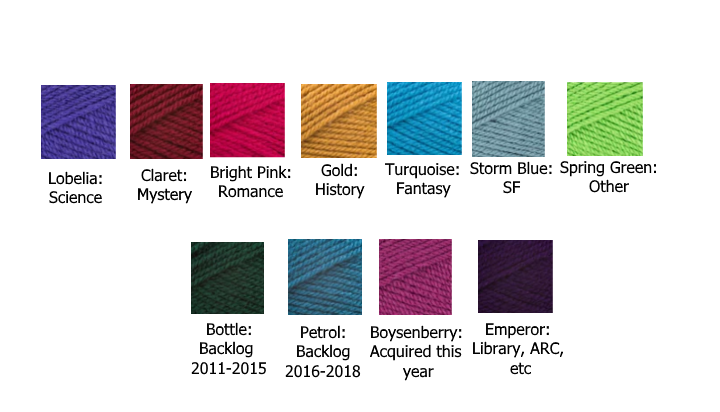
Since last week, I’ve picked out my colour palette (such as it is — my wife was involved, and she loves a riot of colour) and ordered the yarn! So I thought I’d update on the chosen colour palette. Here’s an image with some colour swatches to give you a better idea:

Graphic showing the colours I've chosen for my blanket and what each one means
Graphic showing the colours I’ve chosen for my blanket and what each one means (click to embiggen)

In other words, looking at the table below, for each square I’m going to make the centres out of a colour chosen based on the genre of the book (table A) and then a round in a colour chosen based on the source of the book (table B). If the book covers two genres, I’ll do two rounds for the first genre and two rounds for the second genre.

Table A: Genres and Colours

GenreFantasySFMysteryScienceHistoryRomanceOther
ColourTurquoiseStorm BlueClaretLobeliaGoldBright PinkGrass Green

Table B: Genre and Colour

SourceBacklog 2011-2015Backlog 2016-2018Acquired this yearLibrary, ARC, borrowed, etc
ColourBottlePetrolBoysenberryEmperor
So a book that’s a Mystery/Romance, bought back in 2014, will get two rounds in Claret and two in Bright Pink, followed by a round or two (I haven’t decided yet, it will depend on the size when made) in Bottle. That will have a border in Cream, which will also attach it to the next square. I need to look up how to join with crochet in a blanket, but that shouldn’t take too much effort!

All the colours picked were Stylecraft Special DK; I also got a refer-a-friend link which will get you 15% off a first order from LoveKnitting, which will also give me 15% off my next order for anyone who signs up! Click here for 15% off yarn from LoveKnitting!

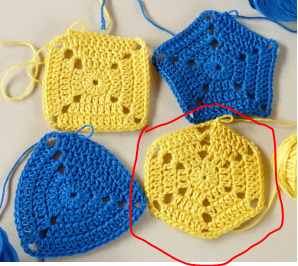
Finally, I also picked out the design: I’m going to keep it simple and go with an expanding geometric hexagon, with the pattern from CrochetSpot — circled in red on this photo from their pattern:

Okay, that’s all for this week! Hopefully next week I’ll have some progress on the actual blanket to show you.

Tags: , ,

Divider

Discussion: Book Blanket

Posted January 7, 2019 by Nicky in General / 8 Comments

While clicking around on Twitter, as you do, I learned about an awesome project some other book nerds are doing. (Full credit: I heard about it from a booktuber, Claire Rosseau.) I’m not much into Instagram or Youtube or whatever, so if there’s a linkup anywhere for web bloggers, someone gimme it and I’ll be right over like a shot.

Anyway, what is this awesome project? A book blanket! Basically, for every book I read in 2019, I crochet a motif to be part of a blanket. Each motif’s colours will be dictated by the book I just read (so for example, if I just read a fantasy book, I’d make a purple square). At the end, I should have a massive blanket of around 250 motifs, if I read roughly the same amount I read last year. It’s going to be epic! (And unlike some of my other blanket projects, it’s very deliberately piecemeal, and so I should be able to do it in little bits as I go along.)

And of course, I’ll blog about every step of the project. When I have an update, I’ll post about it as my discussion post for the week (and when I don’t have any news, which will be most of the time, I’ll think of something else, or post a book review instead). I’ll probably do a couple more of these in January covering my decision process, though, because here I get to combine crochet and books, and that’s pretty awesome.

So! What have I decided so far? I’ve decided that I’ll use acrylic yarn. Any wool-mix is out for me, due to sensitive skin: I can just about work with wool-mixes without problems, but they irritate my skin a lot. Cotton is nice, but could get expensive, and can also be really stiff — not what you want in a big snuggly floppy blanket. So acrylic is my decision: generally hard-wearing, easy to wash, and not too expensive either. And I think I’ll go for DK for the yarn weight; smaller is fiddlier, and there’s a lot more variety available in DK. Chunky yarn is a love of mine, but with 200 motifs, it’d come out too big.

How am I going to join them? Having laboriously sewn a blanket together at the end — a small blanket, at that — I’m going to crochet them together with white yarn. That will give each of them a border, look nice, and can be done as I go along. So I’ll need an extra skein of yarn in white.

To LoveKnitting.com! Having worked with it before and looking at the huge colour selection, I think I’m going to go for Stylecraft Special DK. I’ll probably try and keep the whole thing in the same brand of yarn, to ensure that as much is kept similar as possible, but it shouldn’t matter too much as long as the material and the weight are the same for all the motifs.

Posts to come: colours! Motif type! Maybe a tutorial video or step by step post in which I show you how to make the motif if you want to give it a try!

Tags: , ,

Divider

Discussion: When To Give Up

Posted December 10, 2018 by Nicky in General / 11 Comments

It’s probably not a shock to anyone reading this that I have a large number of books I own, in both ebook and dead tree, that I haven’t yet read. Somewhere around 1,200, I would guess. No, I don’t mean that’s the number of books on my wishlist. I own them, and will quite possibly be crushed to death by them if I’m not careful. My darling wife (who knew full well what she was in for when she married me) kindly went through and figured out exactly how many I have remaining from each year, after Chuckles’ post breaking down her TBR inspired me!

2011: 28 unread (60 listed) – 47% unread
2012: 152 unread (208 listed) – 73% unread
2013: 363 unread (519 listed) – 70% unread
2014: 198 unread (392 listed) – 51% unread
2015: 103 unread (255 listed) – 40% unread
2016: 109 unread (228 listed) – 48% unread
2017: 101 unread (233 listed) – 43% unread
2018: 158 unread (210 listed) – 75% unread

It looks like I was amazingly bad at picking books I actually wanted to read at some point in the last five years in 2012 and 2013 — but it’s not quite so, since the pre-2013 lists don’t include books I bought and had read before the blog started in late 2013. 2018, I put down to the year not being finished yet. The dust hasn’t settled!

The reason this entry is titled “When To Give Up” is because I don’t know when that is. It’s very rare for me to strike off a book on my backlist without trying it, and sometimes even when I have tried it. I guess I’m just reluctant to miss out on something that could be good through feeling like I should have fewer books. Also, I know I’m a mood reader and that you never can guess when I’ll suddenly want to read something obscure from the backlog.

Still, as a little experiment in public accountability, I’m going to include some stats in my Weekly Roundup posts from now on: number of books in, number of books read, and number of books from the backlog read. Let’s see how that goes! I suspect it’s going to find that I am easily distracted by — oh look, a library!

Anyway, there, Mum — was it as bad as you thought? And other readers, how do you think you compare? Do you read books right away, or hoard them like a book dragon?

Tags: ,

Divider

Habitica Bookclub: Why I’m No Longer Talking to White People About Race

Posted December 3, 2018 by Nicky in General / 2 Comments

This month’s randomish pick for the Legendary Book Club on Habitica is Why I’m No Longer Talking To White People About Race, by Reni Eddo-Lodge. I’ve been seeing it around a fair bit, but haven’t read it — and then there it was, in a buy-one-get-one-half-price sale in Waterstones. It seemed like the ideal time, so I added it to the stack, and now it’s my pick for the book club run solely by my own caprice.

I’m particularly interested in the fact that it’s based on experiences of race from a British non-white perspective. So much of the discourse online is based around the experience of black people in the US, which I’ve always been convinced is a different kettle of fish — cue the protests of white Americans who think that I’m being racist to suggest that maybe race isn’t experienced in the same way universally. The idea that it might be different for a African-American person born in the South whose family has been in the US since the 1700s and a hijabi born in Bradford whose parents emigrated as children… is not really widely considered, at least in the circles I run in. The model of racism discussed online has always been rather US-based, ignoring those differences. (And of course the inevitable differences in the ingrained ways of thinking about race.)

I’m also interested because people have such a kneejerk reaction to it, but often when you actually read pieces like that, it turns out the title is really all a lot of other folks have read. (See also: Men Explain Things to Me, by Rebecca Solnit. So much kneejerk angsting from men over an essay that is plainly talking about the habits of a certain kind of man.)

So that’s the background! Assuming I actually get to reading this book within the month this time (alas for The Genius Plague), I’ll try and get a review up and maybe even a discussion post. For now, feel free to comment here if you’ve read the book/plan to read it/think it’s obvious rot from the title alone, and let’s chat!

Tags: , ,

Divider

Discussion: ARCs

Posted November 26, 2018 by Nicky in General / 10 Comments

For some book bloggers, life seems to revolve around ARCs (that’s advance reader’s copies, if you haven’t caught the bug). Getting them, reviewing them, swapping them, collecting them… Some people seem to forget that really they’re being put out there to encourage people to buy the book, especially when it first comes out.

I mean, bloggers end up practically swarming the American Library Association’s annual event, taking along a big suitcase so they can fit in as many review copies as possible — copies really intended for librarians, to help them decide what to order for their own libraries, what to recommend to readers, etc. Some bloggers then go online right after and start selling their ARCs (which if you didn’t know, that’s a big no-no: they’re specifically not legal to be sold).

I mean, I get the appeal, obviously! You get an awesome book before anyone else. I apply or ask for or just receive ARCs in the mail pretty often (mostly apply and ask for, not just get them — or when I do get them, sometimes they’re actually genres I wouldn’t read). Occasionally a publicist will even reach out to me and offer me one! That’s all great. But sometimes… sometimes, guys, I think that book bloggers have lost the plot. ARCs aren’t something we should receive as a right. They cost money to produce, and often a blogger won’t buy a copy of a book they got as an ARC, especially when it’s a print ARC. It can help with buzz, but buzz isn’t sales, and that first couple of weeks is really important for a book — you need readers to be fired up and desperate to get their hands on it!

Often, these days, I think part of it is the “next day delivery” phenomenon (I don’t know about you, but I used to wait a week or two for my book orders, but now I get irrationally annoyed if they take more than a day), the urge to have things right now. Isn’t it an awesome feeling to get it before everyone else?

I don’t know about you, but I’m planning to trying to live more in the moment. I don’t read half the ARCs I’m so grabby about before the book comes out anyway. Let’s get excited about pre-orders again, about reading the book all together the day it’s out instead of on our own months before.

I mean, not that I’m staying off Netgalley or anything. But I’m also not going to whine if I don’t get the book I want. Pinky promise.

Tags: ,

Divider

Discussion: Book Club

Posted November 19, 2018 by Nicky in General / 8 Comments

I’m somewhat convinced to post an opener for my book club choices on Habitica here, starting in December, but in the meantime I wanted to ponder a little about picking books for a book club. It can be really difficult: do you want to pick something people will like, or something people will discuss? Often those won’t be the same thing at all: a book group I was in had months of fruitful discussion about a book we universally loathed, while a book we loved had maybe five comments in the whole thread. The discussion is often better if a book is divisive, too: if one person criticises it and another digs in to defend it, and nobody’s feelings get hurt, there are hours of discussion to be had.

Confession: mostly, I pick the books for the Habitica book club with three criteria: 1) it’s a different genre to the last two months’, 2) I own it and 3) I want to read it sometime soon. The whole intent was to cut out the difficult bit where people vote on a choice or someone forgets that it’s their month to pick or whatever, and just make sure that it’s a book I already own, want to read, and think could prompt some discussion if anyone feels into it. (Most successful pick in a while for the latter is this month’s pick: The Genius Plague, by David Walton.) To a great extent, it’s a commitment device: I told these people I’ll read it, so I guess I’m gonna have to.

(Sometimes it works.)

If I’m picking for a book club in the real world, discussion is probably the primary thing on my mind — but also trying to balance everyone else’s known likes and dislikes. Is this book going to provoke a political argument? Is this book going to just bore X silly? Is Y going to be a child about what happens in chapter ten? Just sharing a book I enjoyed or expect to enjoy has never really worked, mostly because I feel like other people expect something worth discussing.

I’d love a book club where people abandoned lists of discussion questions or considerations of what other people would like. Every month, a different person would bring along a book they just really loved. Okay, discussions would sometimes just be handflappy “omg the bit with X and Y doing the thing!”… but that sounds kind of nice, and I have no doubt that discussions would still arise organically, not due to intent but simply because books are like that, if you give them half a chance. There would be a strict rule about never telling someone else their taste sucks just because it differs.

To be quite fair, my favourite book club is pretty much like that and consists of two people: me and my wife. Discussions are random, tastes mostly align without total agreement ever being likely or desired, and I’ve never had to offer to crown her with a tub of guac. (Sorry, Robert.) Someday, for the sake of Wife Book Club, I might even get round to reading Republic of Thieves.

Tags: ,

Divider

Discussion: Regular Features

Posted November 12, 2018 by Nicky in General / 14 Comments

A lot of bloggers participate in various features every week — Stacking the Shelves, Top Ten Tuesday, What Are You Reading Wednesday… Personally, I kind of cooled on the Top Ten Tuesday themes I was seeing, but there’ve been a couple I liked recently, and maybe I should keep a better eye on that. I prefer to keep my blog mostly reviews, though at the moment it’s kind of half-and-half as I’m not posting a review as well on most days (been reading kind of slow, I guess — I don’t have reviews to post!) that I have another feature running.

At the same time, with features like this I get kind of lazy. I turn out my posts for the regular features and then don’t go and comment on others, and that just feels unfair. It helps if there’s interesting topics and I’m likely to meet other thoughtful bloggers who actually want to discuss (rather than just drop a random comment to get a follow), though.

So, out of curiosity, any you’d like to see me do? And conversely, any that you really hate and wish people would stop posting? I can’t think of any in the latter group for me, though I’m unlikely to participate in any that are just about posting covers.

Really, I’d like to participate in more that encourage talking about books and reading (or sometimes blogging) in a way that promotes discussion and exposure to other people’s thoughts. I do a monthly readalong on Habitica, for instance, and I keep wondering if I should post about that here as well, maybe even come up with some discussion questions, and try and make a bigger thing of it…

Tags: ,

Divider

Discussion: Film Adaptations

Posted November 5, 2018 by Nicky in General / 4 Comments

I don’t think I’ve ever really discussed how I feel about movie adaptations in general. It’s a bit of a hot button topic among book lovers, isn’t it? “The book is always better” purists and those who just don’t trust Hollywood on principle (smart move)… Me? I don’t watch films or TV much at all, so it’s a bit of a moot point. I think comic book movies work really well: it’s a visual medium being adapted into another visual medium, so it’s not quite as tricky, and actors like Robert Downey Jr and Chris Evans have done a good job at somehow embodying the larger than life characters from comics. When it’s done well, it can even bring a new cohesiveness to disparate material — I don’t follow how the fuck most of Marvel’s comics fit together most of the time, but the Cinematic Universe has allowed a lot more interlinking.

(On the other hand, maybe too much. Civil War was billed rather awkwardly as a Captain America movie when it was clearly an Avengers movie. It was about the whole team, not Cap as such. You wouldn’t get away with that in comics; a lot of people follow particular headline characters, not teams and crossovers.)

Books, on the other hand, can be a bit trickier. They’re not a visual medium, and the translation can be harder. I think some movies have done it extremely well — Lord of the Rings, but not the Hobbit, for instance — by taking pains to be as close to the source as possible. Some have been super boring because they stuck close to a book that didn’t translate well, either through narrative voice or through much of the action being in thought rather than deed. Others have benefitted by going off at a right angle (Stardust, Howl’s Moving Castle). Some have just bombed by doing that (The Seeker).

All in all, I think adaptation is an art in itself, which you have to keep in mind as well as film-making. The same goes in the opposite direction — I’m sure a very good book can be written based on a movie, but it can’t just repeat the action word for word. It’s an act of translation to a new medium, and really you need to understand the needs of both media.

Tags: ,

Divider