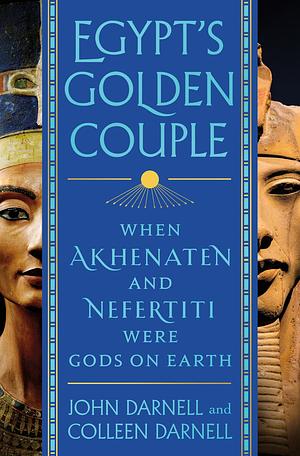
Egypt's Golden Couple: When Akhenaten and Nefertiti Were Gods on Earth
by John Darnell, Colleen Darnell
Genres: History, Non-fictionPages: 384
Rating:

Synopsis:Two celebrated Egyptologists bring to vivid life the intriguing and controversial reign of King Tut's parents.
Akhenaten has been the subject of radically different, even contradictory, biographies. The king has achieved fame as the world's first individual and the first monotheist, but others have seen him as an incestuous tyrant who nearly ruined the kingdom he ruled. The gold funerary mask of his son Tutankhamun and the painted bust of his wife Nefertiti are the most recognizable artifacts from all of ancient Egypt. But who are Akhenaten and Nefertiti? And what can we actually say about rulers who lived more than three thousand years ago?
November 2022 marks the centennial of the discovery of the tomb of Tutankhamun and although "King Tut" is a household name, his nine-year rule pales in comparison to the revolutionary reign of his parents. Akhenaten and Nefertiti became gods on earth by transforming Egyptian solar worship, innovating in art and urban design, and merging religion and politics in ways never attempted before.
Combining fascinating scholarship, detective suspense, and adventurous thrills, Egypt's Golden Couple is a journey through excavations, museums, hieroglyphic texts, and stunning artifacts. From clue to clue, renowned Egyptologists John and Colleen Darnell reconstruct an otherwise untold story of the magnificent reign of Akhenaten and Nefertiti.
John and Colleen Darnell’s Egypt’s Golden Couple focuses on the Amarna period, which of course means Akhenaten and Nefertiti are frequently centre-stage. It’s important to know going in that each chapter begins with a bit of fictional reconstruction, going beyond just explaining finds in an illustrative way and imagining the personalities of Akhenaten and Nefertiti. It isn’t clear how many of the details are grounded in any kind of historical fact, and I find it a pretty suspect way of going about writing history, even history for a popular audience. That’s one of my personal preferences/bugbears, even when it’s fairly unobtrusive, and it’s very frequent in this book: sometimes the fictional sections are as long as the chapter they accompany, or maybe even longer.
I did find the authors’ interpretations of Akhenaten more sympathetic than typical, and directly contradictory to what I previously knew at times. For example, suggesting the letter from an Egyptian queen to the Hittite king Suppiluliuma was from Meritaten, not Akhesenamun as frequently believed. They do put forward a reasonable explanation and they’re not totally alone in making the suggestion, but they don’t mention certain things (like the throne name of the dead king, or the part about the queen not wanting to marry a servant) that would tend to suggest the letter was from Ankhesenamun. The selective nature of some of the evidence is a bit suspect.
Overall, though, I found it interesting to read even though as a layperson I only know enough to know that I’d be wary of accepting any of this completely at face value.
Weirdly, I note that someone comments in their review that there are zero illustrations, but there are plenty — where they are relevant — e.g. reproducing the scenes from stelae that are under discussion. They are in black-and-white, but they are definitely there and appropriately sized and clear enough to examine for yourself.
My rating mostly reflects my dislike of the heavy level of fiction in this book, which I honestly find simply inappropriate. If you want to write a novel about Akhenaten and Nefertiti and their amazing love, then write it; I am certain you will find an audience.
Rating: 2/5 (“it was okay”)

Leave a Reply