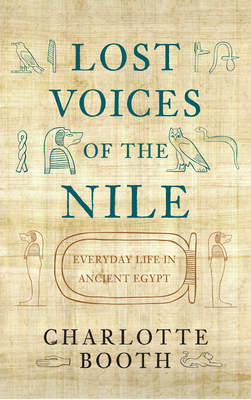
Lost Voices of the Nile: Everyday Life in Ancient Egypt
by Charlotte Booth
Genres: History, Non-fictionPages: 288
Rating:

Synopsis:When we think of ancient Egypt, we think of the gods, the pharaohs and the pyramids. However, life for the average Egyptian was very different from this glorious perception and was not so unrecognisable from the lives we live today. This book tells the history of the ordinary population of ancient Egypt, using the stories of real people - often strange, at times amusing and ultimately very recognisable. Booth introduces us to a number of fascinating people, including Taimhotep, who married a man twice her age and turned to the god Imhotep to help her to conceive a son; Naunakhte, who disinherited her children for neglecting her in her old age; Kenhirkhopshef, a man seemingly obsessed with making lists; and Paneb, the 'bad boy' of Deir el-Medina. History is made up of people and personalities, and each of these characters has a story to tell.
Charlotte Booth’s Lost Voices of the Nile is a pretty thorough discussion of, as the subtitle says, day to day life in ancient Egypt. It does touch on the lives of the rich (especially as we have plentiful evidence for that), but digs through all kinds of sources, not just the tombs of the rich, to figure out what life was like for people of various different social strata in ancient Egypt.
The problem of course is that’s a huge scope: we refer lightly to “ancient Egypt”, but that covers an immense stretch of time. Booth’s pretty good at indicating when the sources she uses come from as well as where and what they are, which helps, but it all adds up to a lot of dense and sometimes dry information… and sometimes there are still inevitable gaps where we’re guessing.
As someone who’s read quite a bit about ancient Egypt, because I never grew out of that phase, I enjoyed a lot and learned a few things — including about the tomb of Khnumhotep and Niankhkhnum, plausibly identified as potentially representing a romantic relationship between the two (though other interpretations are discussed for what they’re worth).
Overall, yeah, a good one, with numbered footnotes (which I always prefer as it makes it much easier to check on sources), but maybe a little dry if you’re not super interested in the topic.
Rating: 4/5 (“really liked it”)

I’ll have to look for this one, it sounds interesting! Though definitely in print form, since I don’t think an audio version would do the footnotes justice. (They so rarely do.)
Nicole @ BookWyrm Knits recently posted…Top Ten Tuesday ~ Books With Nationalities In The Title
Mostly the footnotes/endnotes are just for sources anyway, but I suspect it’d be a tough one to keep track of in audio…
I definitely would need something more beginning friendly, but I always use Egypt as an example in my mthology elective of how massive chunks of time were. Kids are complaining that gods have different names/merged/etc. It leads to some fun discussions about how storytelling has just changed fundamentally
Cosmic recently posted…My Favorite Magic Schools
The amount of time that “ancient Egypt” covers is mind-boggling!