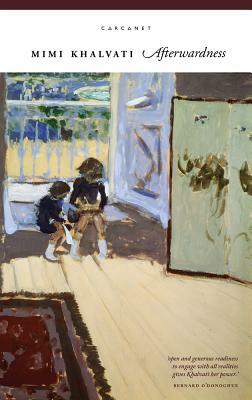
Afterwardness
by Mimi Khalvati
Genres: PoetryPages: 72
Rating:

Synopsis:A 2019 Poetry Book Society Winter Wild Card. A Sunday Times Book of the Year 2019. Ever since her first Carcanet book, In White Ink (1991), Mimi Khalvati has been drawn to the sonnet form. In Afterwardness its pull became irresistible. She has created in this unprogrammatic series, mixing memory, history, daily life, all her intersecting geographies and cultures, a self-portrait in all her moods, anxieties and delights. The sonnet form is stretched in all sorts of fruitful directions. Just as she adapted the ghazal form to English use, here she puts the Petrarchan sonnet to striking, unfamiliar use, widening the possibilities of the form. The poems are rich with Khalvati's personal history, her Iranian origins, her long years in Great Britain. The poems play between cultures, ancestral and acquired.
It’s been a while since I tried to think super deeply about poetry so I’m sure I missed a lot of what Khalvati was trying to do by using the sonnet form. I think I read that they’re all Petrarchan sonnets, but I thought those were an octave and a sestet, while I picked a couple of Khalvati’s poems and they didn’t match that ABBAABBA rhyme scheme (and nor were they arranged into an octave and a sestet). So not sure about that, probably I’m missing a lot there.
All the same, I enjoyed the way Khalvati writes, and found her poems pretty accessible. I think I might’ve enjoyed them more with a tiny bit more context about Khalvati to place some of her references (like the fact that she’s Iranian) — I tend to be that kind of reader, not so much because I want to assume that the poet is always writing about personal experience, but to understand where they’re coming from, the context that shaped the poem.
I’m going to read more of Khalvati’s work for sure — this was a good experiment.

Leave a Reply