Tag: discussions

Discussion: How Do You Review?

Posted October 1, 2018 by Nicky in General / 13 Comments

I might have posted about this before, but honestly, I don’t think I’ve yet hit upon a way to review books that works for every book, and that really satisfies me looking back. After a while I read back some of my reviews and I’ve been so vague about what the book was about that it doesn’t remind me (although I can always tell whether I liked the book or not — but that usually sticks with me anyway) and a lot of my reviews come out the same. The past week I’ve started trying to be more descriptive: set the scene a bit more, for one thing, particularly because I don’t include the publisher’s summary when I post a review. I still don’t have a set procedure for myself, though — honestly, writing to a checklist makes my reviews feel all the same in another way, and makes the whole process even more mechanical and wooden.

How I go about writing reviews, generally… hmm: first, a sentence or two about how I came to pick up the book, or how I felt about doing so. ‘This book has been really hyped for months, so I finally succumbed when I saw it at the library’ — that kind of thing. Then I’m now trying to get in a bit of description — the major ideas of the book and what I think about that and the setting… I don’t want to put in spoilers, but I do try to give some idea of how it develops. And then last, what jumped out at me, for good or ill? Characters, plot points, did it remind me of something, did it go off the rails… And finally, I try and comment on who I think might like it, if the rest of my review hasn’t made it obvious. And at the ending, at the request of some of my earliest blog readers, a star rating out of five.

With non-fiction, of course, it’s a bit different; I try to explain why I’m interested and what my existing level of knowledge is, the stuff the book covers, whether the writing style is clear, and then maybe in the end who I’d recommend it for.

Of course, every so often I’ll lose my head and do something different, maybe even write a little story. But for the most part, the above is what I try to do, or am trying to do now.

So what do you put into your reviews?

Tags: ,

Divider

Discussion: Keeping Books

Posted September 24, 2018 by Nicky in General / 9 Comments

Do you hoard your books? Or do you keep everything you’ve ever bought in a massive book hoard?

While I do have quite the book hoard (ahem), it’s mostly books I haven’t read yet, or intend to read again. I try not to be overly sentimental, or precious about having spent money: even having paid full price for a book, I’m still quite happy to let it go, preferably to a charity shop or a library if I can’t recoup much of the cost. (There was a store in Belgium that bought a lot of my second-hand books as they were in good condition and in English, which people do want in Belgium but can get very expensive. I doubt that’s going to be as easy now I’m back in the UK full time!) Even having received it as a gift, I’m in line with Marie Kondo on this one: the purpose of the gift has been fulfilled, and it’s no disrespect to the gift to hand it on where it can be enjoyed more. In the case of books I bought myself, I’ve supported the author and now handing on their book has a chance of introducing someone else to their works for the first time.

I do keep a fair number of books, though. You can bet I still have Ancillary Justice and Assassin’s Apprentice and The Grand Sophy and Gaudy Night… and a whole succession of other books. If I’m pretty sure I’ll want to reread it someday, I’ll keep it. After all, there’s no point in buying it twice (though I have done that in the case of ebooks, to have a handy e-copy). Still, if it’s easy to get from the library and it wasn’t a 4-5 star read, I probably won’t keep it even if I could see myself rereading it (e.g. to finish the series). I’m not much for keeping books for pretty covers, either.

Personally, I have limited space (alas) and I always need room for more books. Donating them (or sometimes selling them, or giving them to a friend) is the best way to keep my library rotating. Okay, financially I shudder to think of the turnover, but the joy I get out of it is more than enough.

So how about you? Chronic keeper? Or do books barely touch the shelves before they’re out again?

Tags: ,

Divider

Discussion: Shelving

Posted September 17, 2018 by Nicky in General / 8 Comments

So I’m in the new flat and getting everything sorted, and of course the big question arises: how should I categorise my books?! I know some people who don’t bother, or even weirder to me, sort them via totally arbitrary criteria like spine colour, or the size of the book.

To me, the whole point of the shelves is to make the books accessible, so it needs to be useful as well. My books get roughly separated by genre and then alphabetised by the author’s surname — and within an author, I tend to go by publication order if I’m feeling really obsessive. Series definitely need to be together and sorted in order! Size and colour don’t matter to me, unless they don’t fit on the shelf, in which case taller books do go on a separate, taller shelf.

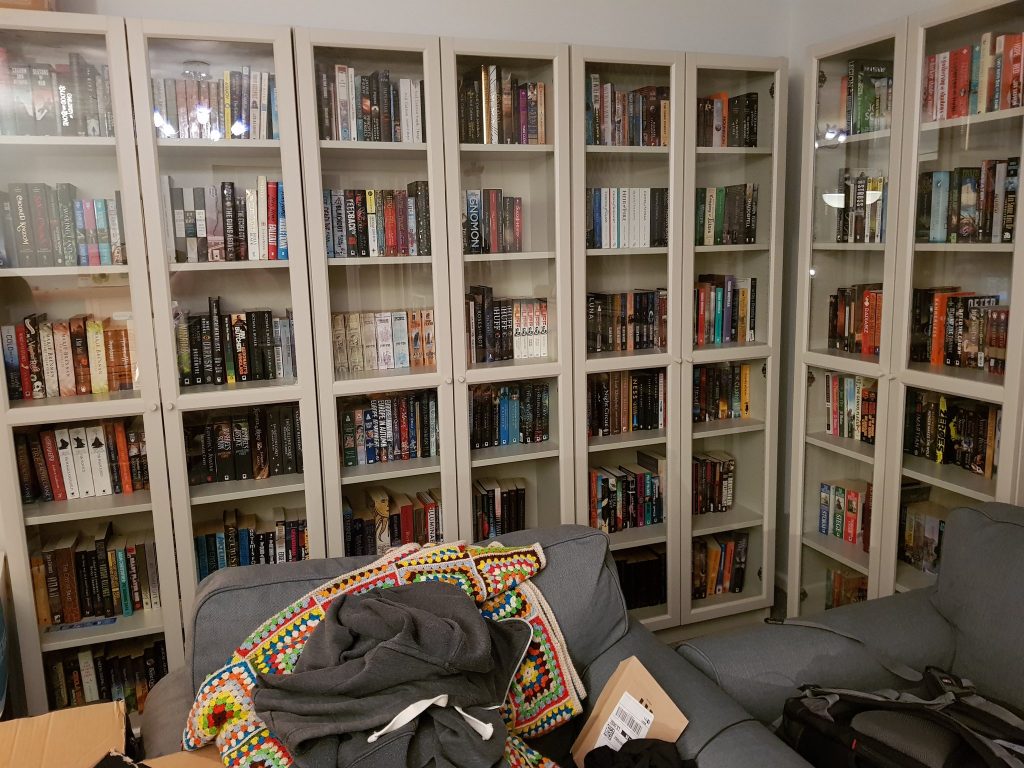
The breakdown for my books is pretty unsurprising: there’s four bookcases in the living room full to the brim with fantasy and sci-fi…

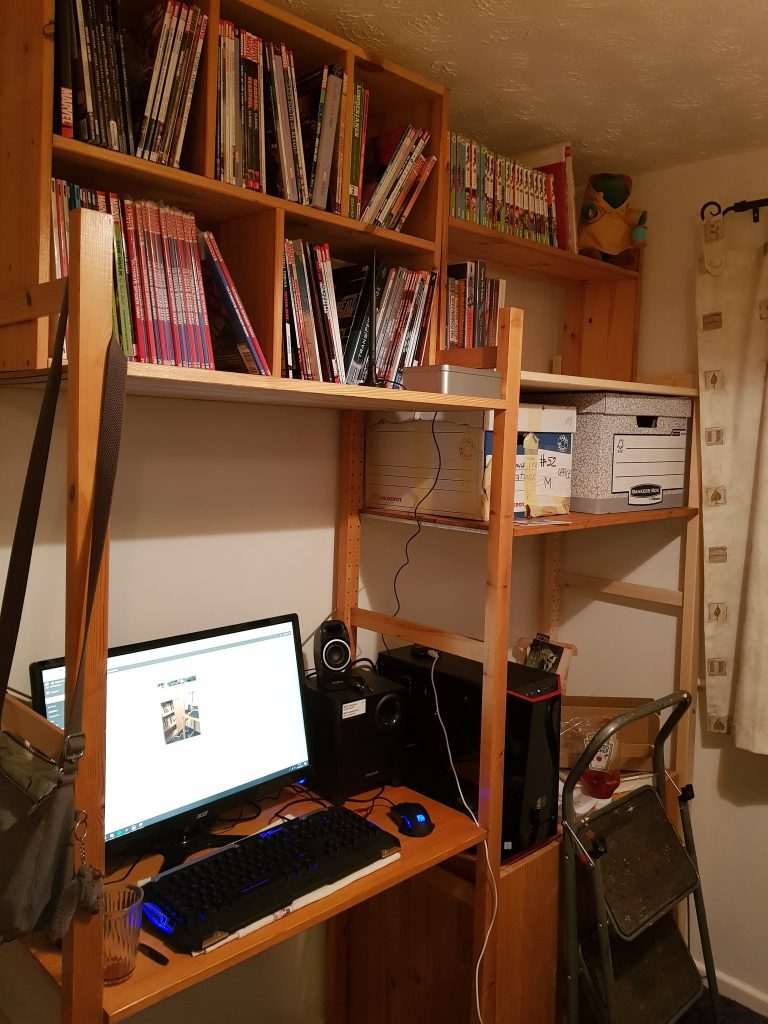
There’s a half-size bookcase in my office which is two thirds full of pop history books…

Comics go on the unit above, and I do have a separate section for library books as well…

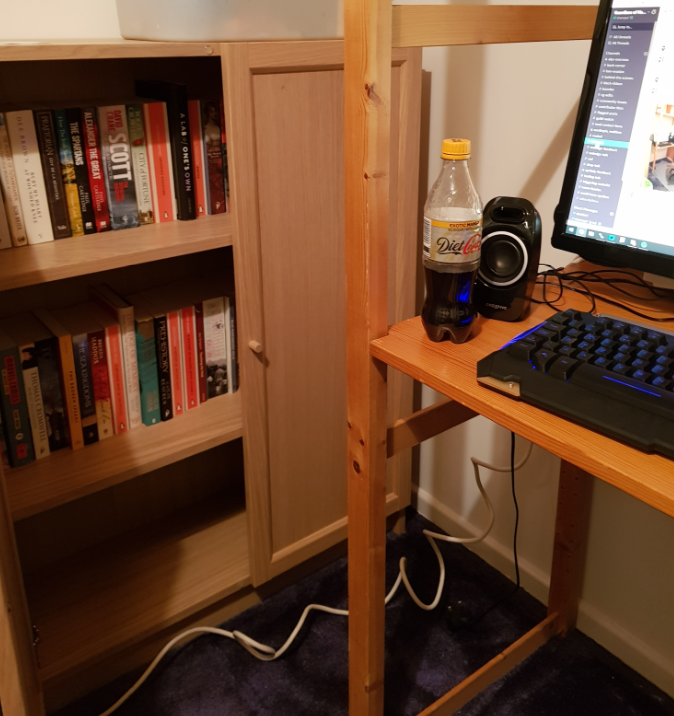
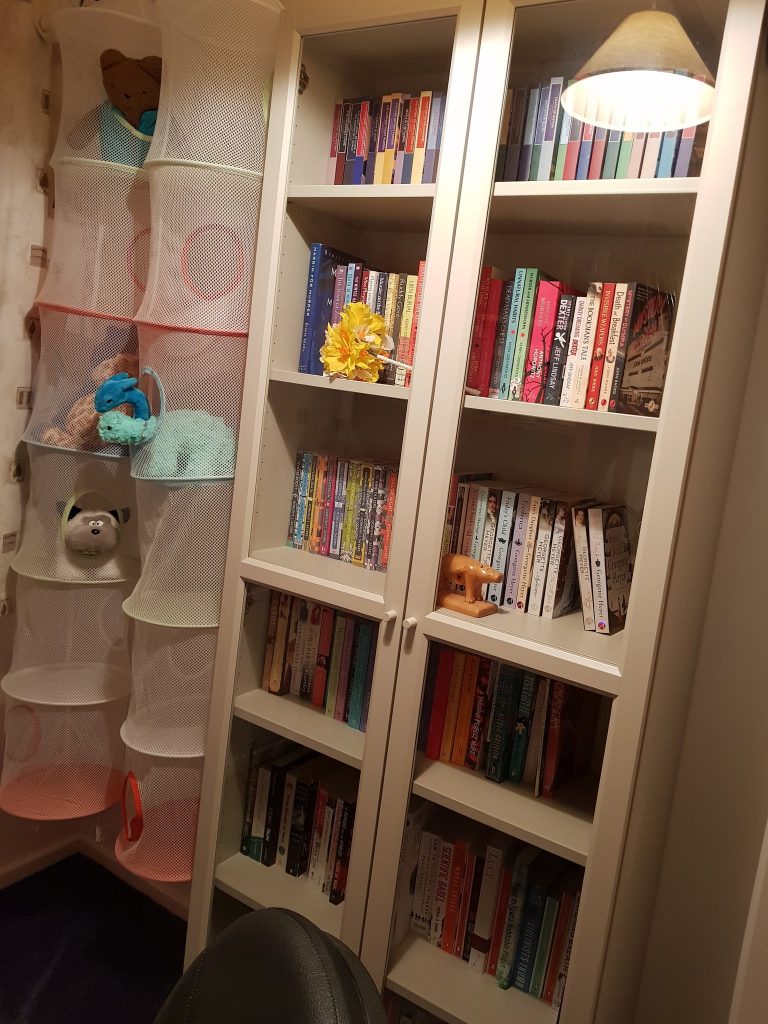
Then the full size bookcase behind me is a bit of a miscellanea: a few shelves of crime fiction, some historical fiction, some romance, and then two shelves of pop science.

So how do you categorise your books? Please tell me it’s not by colour… (I mean, I kid. Do what you like. But what earthly use is that?!)

Tags: ,

Divider

Discussion: Too Many Books At Once

Posted September 10, 2018 by Nicky in General / 14 Comments

Too many books spoil the broth? Hmm… not quite right. Well, I mean, they would, but it’s not quite in the spirit of the proverb.

…Anyway, this week’s discussion post is about reading multiple books simultaneously. I know a lot of people hate doing that, feeling that they lose the thread of the plot or there’s just too much to pay attention to, and I get it. I just can’t sit still for long enough — I’m very much a mood reader, and that means if a book is taking me ages and isn’t something I’m super in the mood to read, I’ll pick up something else to fill in the gaps. The problem occurs when I then pick up another book to supplement that, and… on and on it goes.

Personally, I think you all know my Golden Rule of Reading: have fun, and don’t ever let it become a chore. I did try to reduce the number of books I had on the go at once, because sometimes it is a little stressful or I end up not making progress on a book for ages even though I was enjoying it… but overall, I prefer to give myself the flexibility to just put a book down and come back later, because I don’t ever want to feel resentful about reading or annoyed that I’m dying to pick up Book X but I’m stuck on Book Y. I don’t think it’d work if I read books all in the same genre — they might blur into each other — but maybe it helps that I’m all over the reading map.

So yeah, I refuse to have shame about my currently-reading pile. Vive la stack!

Tags: ,

Divider

Discussion: Buying a Series

Posted September 3, 2018 by Nicky in General / 6 Comments

As with a lot of my discussion posts, this is basically prompted by authors posting on Twitter. In this case, authors are often to be found urging you not to wait for a series to be over before buying their books. There’s solid reasons for that, of course — if people don’t buy the first book in a series, publishers are probably not going to bother taking the risk of publishing the second book — let alone commit to an extended series in hopes that in ten years or so, once it’s complete, people will finally flock to buy the thing.

As a reader, though, I find authorial reproach on this topic… ugh, irritating isn’t the word, because it sounds unfair. But to me, it’s also unfair to expect readers to make an investment in a series right out of the gate, without it even being clear when the next books will come out, how long it’s going to take, how long the series might be, whether things are planned in advance… I would never bother to read the first book of a fantasy trilogy when it’s just the debut novel, for certain: I don’t want to be stuck in Scott Lynch-esque limbo. (I’m with Neil Gaiman — [author name] is not your bitch — but it’s been disappointing as a fan. And in that case, it wasn’t even after the debut novel that things slowed down. There were two books out in reasonably quick succession; it looked like a good bet!)

And of course, I don’t want to buy a book that I’m not going to read until I know when the next one is out. I have a backlog of over a thousand books; if nothing else, I don’t want to purchase something in order to have it sit there for five years inflating my counts and clogging my shelves.

Putting up a discussion post might imply I have an answer, but I really don’t. I don’t have a solid policy: I’ll buy a debut novel if it looks interesting, and I might even read it and risk spending five years waiting for the next book. But it’s something I really would like to balance out somehow: authors’ need for an audience, my desire to feel that I’m not gambling on the next book ever existing…

So hey, what do you guys do? Buy the first book and not read it? Buy the first book and read it and hope to goodness the next comes soon? Stubbornly hold out for the series’ end?

Tags: ,

Divider

Discussion: A Fast Read

Posted August 27, 2018 by Nicky in General / 4 Comments

I can’t remember which author it is, but there’s someone on Twitter who gets deeply offended whenever someone says, “Hey, I found your book a really fast read, totally unputdownable!” They completely take it as an insult, because they don’t want to be the kind of author who writes books that might be classed as easy to read.

Authors: please don’t do this. If I read your book fast, it is a compliment, and you’re just willfully taking offence if you decide that it isn’t. I’m a fast reader anyway, and it doesn’t mean that I don’t take in what I’m reading or appreciate your subtleties. How fast I read a book is much less important than how long it stays with me afterwards: there are books which take me months to read and feel like a total chore — do you really want to be one of those?! Because if your book is one of those, I can almost guarantee you… I don’t like it that much.

(There are some exceptions, mood reading and such. But in general…)

Now, there is a time and a place for close-reading. 1) A literature degree, 2) understanding how something is put together because it’s just that fascinating, and 3) you enjoy doing it. I’ve done close-reading for all three reasons — it’s not an impossible thing to hope that someone might do at some point — but most readers aren’t interested in doing that, and most of us just read at our own speed, and savour the book (or not) in our own way.

It’s a compliment, I swear. Chill.

Tags: ,

Divider

Discussion: Half Stars

Posted August 20, 2018 by Nicky in General / 8 Comments

It’s come up a couple of times lately when I’ve rated a book — I experience a fleeting wish for half stars. I used to be pretty active in the Goodreads Feedback Group, and that was perennial plea: give us half stars! And I don’t really actually get it, most of the time, if I’m honest. I mean, the Goodreads rating system goes like this:

5 stars: it was amazing
4 stars: I really liked it
3 stars: I liked it
2 stars: it was OK
1 star: terrible

I can’t remember if that’s the exact wording or not, but you get the gist. Now I don’t really see how that leaves room for intermediates (unless you’re just not using the scale at all, but then you can do whatever you like anyway and state that you’re awarding half stars in your review). Making it more granular makes it harder to decide, for me at least — and yet the cry was always, “well, I need half stars because I can’t decide between four and five!” To me, I don’t see how that helps: now you have more stars and they have ambiguous meanings (“I half really liked it!”) and surely that could lead to infinite regression. Quarter stars, eighth stars, sixteenth stars…

Nah, I’ll stick to full stars. If I was rating something to suggest whether a publisher should pick it up, maybe there’d be more need for precision. But it’s not like the ratings are actually precise anyway: how many times can you say you liked two books exactly the same?

I just don’t get it, I guess. A simple five star scale is enough for me in terms of giving a sense of where I am on the continuum — and having the stars weighted towards the positive end makes sense, too, because it’s not as important to know how much someone disliked a book as how much someone liked a book.

Probably this is all just me, but hey, now you know why I don’t use half-stars and rarely talk about wanting to use them: if I do, I really am on the fence, and usually it’s because I think a book deserves a higher score for technical merit, but I didn’t like it. (And all my star ratings are based on liking, so giving some things four stars is just lying, no matter how technically brilliant I think they are.)

So how do you rate books? Do you have a system, or do you go with your gut?

And hey, happy birthday to me!

Tags: ,

Divider

Discussion: Who are reviews for?

Posted August 13, 2018 by Nicky in General / 11 Comments

I saw this on Twitter (this thread) and immediately had a ton of thoughts, especially after I saw the tweet claiming that reviews (in general) are for everyone: authors, readers, other reviewers… And in one way, that’s true; there’s no way I can stop authors coming to my blog and reading my reviews, and maybe they’ll be useful to authors too! I don’t begrudge them to authors, if they’ve got thick skins and can keep themselves from arguing with me.

But. With every piece of writing, you have an audience in mind. That’s part of what makes the writing effective: you tailor it to the people you want it to be useful to. It’s no use me posting here talking about the MIC of bedaquiline against Mycobacterium tuberculosis — you’re a smart bunch, so I’m sure some of you know what the MIC is and what it’s about, but it’s simply not relevant to most people — and likewise there’s no point in me using a chatty style in my dissertation. The audience distinction between other readers and the author of the thing being reviewed is not necessarily that large, but I’m definitely not keeping the author in mind when I review. I’m talking about what I liked and what I didn’t, and often don’t even touch on anything beyond personal taste. Now, unless an author’s planning to write a book just for me, that’s not exactly useful, is it?

Now, reading the actual thread, I don’t think me and the writer of that thread are actually too far apart in our opinions. I don’t disagree that reviews are open to and worth scrutinising, etc, etc. But all the same, I have an audience in mind for my reviews and it’s not authors (and it’s not really non-readers, either: I don’t see why a non-reader would be interested in my reviews). So sure, my reviews can be read by anyone who comes along and maybe they’ll be of interest or even useful for people whom I don’t expect to find them so.

But still, saying my reviews are for anybody I don’t think they’re for is putting a bit much of a burden on the rather slender shoulders of my typically 200-word-ish summaries of what I thought of a book. And I don’t think most people who are saying that reviews aren’t for authors or aren’t for xyz are saying that their reviews can’t/shouldn’t/mustn’t be read by those people — they’re saying, fucking Christ, will authors please stop commenting on my reviews to browbeat me because I didn’t like their book. So in that sense, yeah. Reviews are for other readers. Fight me.

(Please don’t.)

Tags: ,

Divider

Discussion: Rites of the Reader

Posted August 6, 2018 by Nicky in General / 6 Comments

Because I love my puns.

I don’t know about other people, but over time I’ve had quite a few different quirks and rituals about reading (hi, my name is Nikki, I have obsessive-compulsive tendencies). When I was a kid, I actually used to read sitting on the staircase (I don’t know why) and so the ritual was to move down a step with every chapter finished. I got through many a Famous Five book that way. The only hitch was that I couldn’t leave the stairs until I’d finished a book. That could be… awkward.

I also had a thing where I couldn’t stop on an odd-numbered chapter, or in the middle of a page. (But for some reason, it was okay to stop at the end of the first paragraph on the page, as long as it was a continuation from the previous page, and not a new paragraph.) And then there was the thing with putting bookmarks ahead of myself in the book, and then I couldn’t stop until I got to them.

I’m mostly over all of those now, actually. I do still prefer to finish a chapter, but I can be pulled away from my book when necessary. I do like putting a bookmark ahead of myself to mark a stopping point or something that I want to get to. My main rituals surrounding reading now, though, are “bookbed” — me and my wife go to bed early to read — and the fact that I inevitably can’t sleep when she does, and so normally stay awake long into the night reading! I can’t really think of anything else.

So what’re your little quirks — the things you have to do when reading, or your ways of storing books, or… anything like that?

Tags: ,

Divider

Discussion: The Rights of the Reader

Posted July 30, 2018 by Nicky in General / 6 Comments

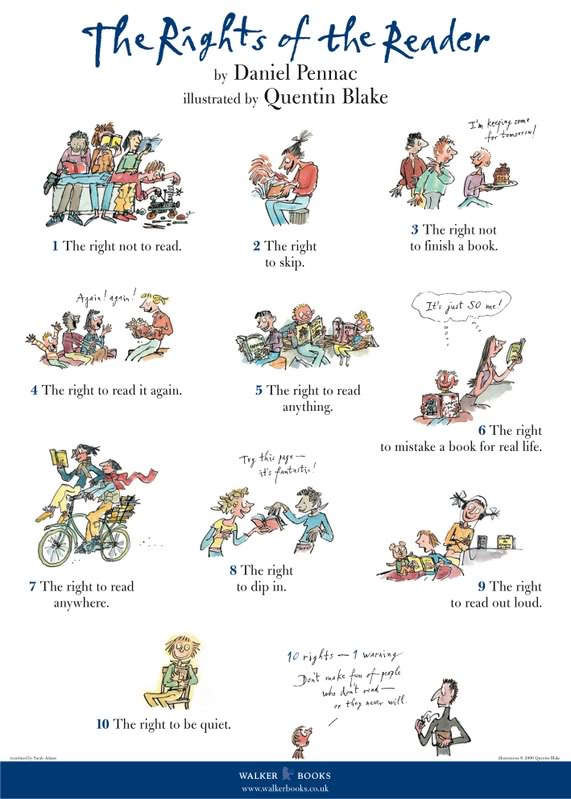
I’m fairly sure a lot of people have heard of Daniel Pennac’s book, The Rights of the Reader, maybe without knowing quite where it comes from (since the book itself is originally in French). Quentin Blake’s illustrations help with that, given the posters of the rights plus his illustrations that you can get, and I know I have seen those around.

Anyway, if you’re curious you can read my review of the book here, which is mostly about getting kids reading instead of the rules’ general applicability, but this post is actually about the rights themselves. And here they are, illustrated by Quentin Blake (click to embiggen):

  1. The right not to read.
    Seems like good sense to me. Who wants to feel forced to read? There are some situations where I guess you do have to read the book, like literature classes. Even there, I think there should be room for wriggling. I did a crime fiction course at Cardiff University, and one of the books included was a transphobic, rapey mess with tortures lovingly described in practically every chapter. I did feel that maybe we should’ve at least been given some warning about that one.
    Also, you know that feeling where everyone’s been reading a book so you should hurry up and do it too? Yeah, I think this right covers that, too. Read what you want to, when you want to. In other words, Mum, I’ll read Republic of Thieves when I’m good and ready.
  2. The right to skip.
    Read the ending first? Skip a gross scene or a boring chapter? Skip ahead to your favourite bit? All good with me, I’m all for this right.
  3. The right not to finish a book.
    I know a lot of people don’t like not finishing a book, but I’m all for it — I’ve already done a discussion post about it. Again, I just don’t see the point in feeling forced to read something you’re not enjoying. Unless you’re sort of masochistic about books, I guess. Actually, Quentin Blake’s illustration looks like he’s thinking that means just waiting to finish a book you’re enjoying, and hey, that’s valid too.
  4. The right to read it again.
    Something I’m clearly for, if you hang around here at all. Again, I have a whole post on it.
  5. The right to read anything.
    Screw the idea of guilty pleasures or feeling weird because the book’s actually aimed at middle grade readers or whatever. Read for pure joy and if it makes you happy, that’s great.
  6. The right to mistake a book for real life. 
    “It me!” Also referred to in the book as “Bovary-ism”. Because who doesn’t want to imagine they’re an interdimensional Librarian? Honestly, I’m not entirely sure what this one is meant to mean anymore, but if it means getting so caught up in a book it matters more than whatever else is on your plate, I’ve been there and done that and those are some of the absolute best books.
  7. The right to read anywhere.
    Okay, don’t do anything dangerous, but if you want to read sitting in the kitchen sink (high five if you know that reference) or while walking (with a careful eye on traffic) to work, then more power to you. I’ve read in bed, on trains, on planes, sitting on the stairs, sitting on a wall, sitting in the hall… and I’ve no doubt the list will keep growing.
  8. The right to dip in.
    Sounds a bit like the right to skip, to me. Actually, I’m kind of against this one for myself — I start at the beginning and go on until I come to the end, or give up. But hey, if you like reading random chapters or the middle book of a series, why not?
  9. The right to read out loud.
    I actually like to whisper the words to myself as I read. It’s not like I read to, and I read faster silently, but I love the shape and taste of words, and I kinda hate that I have to give that up in public for fear of being weird. (Also when my sister is in the room, because the whispers annoy her.)
  10. The right to be quiet.
    Nobody should disturb you when you’re reading.

I can think of some other ones, some more silly than others — the right to fill a book with bookmarks at strategic points while I’m reading so I can track my progress. The right to babble to others about the exciting thing I’m reading. The right to give other people books you think they’ll love. The right to differ from other people about a book (I’m sorry, I just don’t get some authors).

But really, it all comes down to one golden rule, which if you read my blog you can probably guess. Everyone deserves…

THE RIGHT TO ENJOY THE HECK OUT OF READING BY WHATEVER MEANS NECESSARY FOR THEM.

Tags: ,

Divider