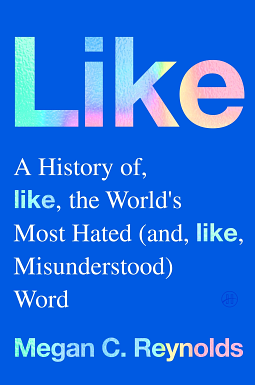
Like: A History of the World's Most Hated (and Misunderstood) Word
by Megan C. Reynolds
Genres: Linguistics, Non-fictionPages: 256
Rating:

Synopsis:A comprehensive and thought-provoking investigation into one of the most polarizing words in the English language.
Few words in the English language are as misunderstood as “like.” Indeed, excessive use of this word is a surefire way to make those who pride themselves on propriety, both grammatical and otherwise, feel compelled to issue correctives.
But what the detractors of this word fail to understand is its true function and versatility—as an exclamation, a filler of space, a means of subtle emphasis, and more. “Like” may have started out as slang, but it is now an intrinsic component of fun, serious, and altogether nurturing communication. And like any colloquialism, the word endears the speaker to its audience; a conversation full of likes feels more casual, despite its content.
In this book, culture writer and editor for Dwell magazine Megan C. Reynolds takes us through the unique etymology and usage of this oft-reviled word, highlighting how it is often used to undermine people who are traditionally seen as having less status in society—women, younger people, people from specific subcultures—and how, if thought about differently, it might open up a new way of communication and validation. Written in a breezy yet informative and engaging style, this is a must-read for anyone who considers themselves a grammarian, a lover of language, and an advocate for the marginalized in discussions of cultural capital, power, and progress.
I’m not entirely sure where I originally heard about Megan C. Reynolds’ Like: A History of the World’s Most Hated (And Misunderstood) Word; I thought it was on Litsy, but the review I’d have been most likely to see there was fairly ambivalent. Maybe it was Litsy and I was just curious despite the reservations. In any case, I’m glad I gave it a shot, even though I agree that I wasn’t bowled over by it.
First: I agree with Reynolds’ points that the word “like” serves a useful purpose in casual and spoken communications, for sure, and that those who really hate it often do so out of sexism and ageism because it’s associated with young women in particular (despite actually being fairly widespread).
However, I did find that Reynolds’ introduction rambled and went on a personal tangent several times, while the various chapters wandered around, visited anecdotes, went off into blind alleys, etc. This book is as much about Reynolds’ feelings about communicating as anything, and she admits she isn’t a linguist. So that’s worth knowing going in for a start: it’s rambly, with lots of personal stuff squeezed in so you know that she has a cousin who she doesn’t speak to anymore who said she talks too much in a rude way, etc, etc. You get to know way too much about her fear of being vulnerable and her interest in stuff like “radical candour”. This is a matter of personal taste — maybe you like this in your books, but I don’t. Or at least, I didn’t in this case, not least because I don’t think I’d get on with the author.
It’s also worth knowing that despite stating her fear about robotics and AI, Reynolds is all-in on AI. This bit was honestly just bizarre to read:
Despite the obvious and alarming implications AI software and machine learning carry, ChatGPT is a tool that can occasionally be useful. Embarrasingly, ChatGPT is a useful starting point for guidance in interpersonal situations that you’ve already talked through to death with every single one of your friends and anyone who will listen, so much so that by now the opinions of others have merged with your own. When a situation calls for true impartiality, AI is a neutral party with no skin in the game. If you ever find yourself in a position where you desperately and immediately need a list of suggestions on how to set and uphold boundaries, ChatGPT will deliver, providing useful information that answers the prompt in an objective manner. The results are serviceable and delivered in a tone devoid of personality or opinion.
Just, overall, really weak — and weaker the more I think about it, since the main points would be more impactfully stated in a much, much shorter essay, with a lot of extra padding cut out. I should probably have DNFed it when I hit the LLM part, but… sunk cost fallacy, I guess?!