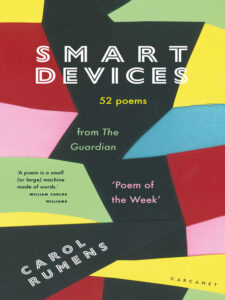
Smart Devices
by Carol Rumens (editor)
Genres: Lit Crit, Non-fiction, PoetryPages: 256
Rating:

Synopsis:A year of hand-picked poems and commentaries from the Guardian's 'Poem of the Week' blog.
Carol Rumens has been contributing 'Poem of the Week' to the Guardian for more than a dozen years. Do the maths: that's more than 624 blogs! No wonder she has a large and devoted following. She's a poet-reader, not an academic. She is fascinated by the new, but her interest is instructed by the classic poems she has read. They make her ear demanding: when it hears that something, it perks up. She perks up. 'A poem is a small (or large) machine made of words.' Rumens partly agrees with Williams but she develops the conceit, seeing each poem 'as a more flexible instrument, a miniature neo-cortex, that super-connective, super-layered smartest device of the mammalian brain'. She tries to avoid poems built from kits with instruction manuals. She looks for surprises, and she surprises us.
Smart Devices is a collection of Carol Rumens’ choices for The Guardian‘s poem of the week column. If you’re expecting pretention, then, well, you’re not wrong — both from the editor and, if you peek at the comments section, the commenters as well. Here are some choice examples…
…and there, self-condemned by poetically just circularity, one has all of the acorn and the oak that LockJock has to contribute.
Aaand:
Now that sentence tells me a lot about you, the sense of natural entitlement, the geography of your life.
There are some interesting choices of poem, and definitely some poets I’m going to look up and read more of, but getting through the commentary by the editor alone can be quite the feat, and I ended up skimming a number of them because you just get stuff like this:
Among the most readable of the avant garde poets, Langley has occasionally stirred in me what I term the Kenneth Williams effect. The wonderful fabric of his observation would suddenly break or knot, at which point I’d think: “Oh, stop messin’ about. You’re too good for trendy-bendy tricks.” But I was wrong. These weren’t tricks but simply flying sparks, thrown off by language during the process of cutting and drilling through to a cleaner kind of origination. Certainly in the post-millennial collections, there’s no sense of participation in any langpo-regiment’s smartbombing of the synapses. Langley is a purer breed of iconoclast, on a scrupulous quest for revealing what his eye has seen and his mind understood. Despite some serious play, he doesn’t mess about.
Poetry — and commentary on poetry — doesn’t have to be this pretentious. I got a BA (first class honours) and MA in English literature, and I never wrote anything like “cutting and drilling through to a cleaner kind of origination”. Half of it is hot air meant to make it sound like you’re intelligently commenting on the poem.
This is, of course, a matter of taste; certainly some of the other graduates wrote like this and were rewarded for it. It’s not a bad collection for introducing one to a range of poems, including some in translation (though I stumbled through reading the original of the one in French just to see if I still could, since it was included, and surprised myself!).
Rating: 2/5 (“it was okay”)
