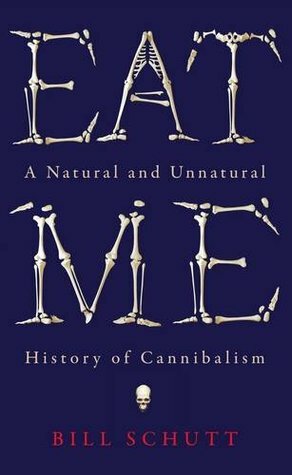
Eat Me: History of Cannibalism
by Bill Schutt
Genres: History, Non-fiction, SciencePages: 270
Rating:

Synopsis:At last, something to really get your teeth into: an entertaining, informative and gruesome look at the world's greatest taboo.
Cannibalism. It's the last, greatest taboo: the stuff of urban legends and ancient myths, airline crashes and Captain Cook. But while we might get a thrill at the thought of the black widow spider's gruesome mating habits or the tragic fate of the nineteenth-century Donner Party pioneers, today cannibalism belongs to history - or, at the very least, the realm of the weird, the rare and the very far away. Doesn't it?
Here, zoologist Bill Schutt digs his teeth into the subject to find an answer that is as surprising as it is unsettling. From the plot of Psycho to the ritual of the Eucharist, cannibalism is woven into our history, our culture - even our medicine. And in the natural world, eating your own kind is everything from a survival strategy - practiced by polar bears and hamsters alike - to an evolutionary adaption like that found in sand tiger sharks, who, by the time they are born, will have eaten all but one of their siblings in the womb.
Dark, fascinating and endlessly curious, Eat Me delves into human and animal cannibalism to find a story of colonialism, religion, anthropology, dinosaurs, ancient humans and modern consequences, from the terrible 'laughing death' disease kuru to the BSE crisis. And - of course - our intrepid author tries it out for himself.
Disclaimer up front: a few people were very weirded out and uneasy at the whole idea of anyone reading a book about cannibalism, so please note that it’s from a reputable publisher (the Wellcome Trust) and is history/science, not true crime, not sensationalism, and certainly not any kind of advocacy for cannibalism. I picked it a bit at random, because I like to learn a little bit about a lot of things. As a reminder, I also have an MSc in infectious diseases, to which this book is relevant because it discusses BSE, CJD, scrapie and kuru, all diseases which we now know to be transmitted via voluntary and involuntary cannibalism.
So, that out of the way: I found Bill Schutt’s Eat Me: A Natural and Unnatural History of Cannibalism a little uneven: I thought many of the topics discussed were interesting, and I appreciated that he mostly avoided discussing cannibal serial killers due to living families of victims and the lack of wish to give these people the notoriety they often crave, buuuut I thought eating a bit of someone’s placenta in order to call oneself a cannibal on the cover of the book (without explaining it was placentophagy!) was a bit much.
The book discusses not just human cannibalism but starts by discussing cannibalism in the wider animal kingdom: when it happens and why, what advantages it might offer, why it’s sometimes disadvantageous. There are some fascinating titbits there. I was less interested in dissecting why some groups eat people during disaster situations, as honestly that doesn’t seem very surprising to me (though of course there’s some interesting psychology around it), and I wouldn’t have minded a bit more focus on societies where cannibalism was reserved for close family members, as part of funerary rites. That part was mostly discussed through the lens of kuru, which is fascinating, but doesn’t get at the why of it, how people feel about it, how grief works in that situation.
There is a bit about prion diseases in general which I thought was interesting: although scientists usually state that prion diseases involve infectious proteins, there is a team trying to show that the proteins are a symptom, or even a defence, and viruses are actually the cause. The best proof seems to be a study using nucleases to destroy nucleic acids in prion samples and thus reducing infectivity by >99%, which does make it sound like there’s nucleic acid (RNA/DNA) at work rather than proteins alone… but the main author also likes to refer to herself as the “prion heretic”, so I’m a bit… not sure. More digging needed on that (and I’d welcome any links to recent papers anyone has to share on the topic that address this) but definitely an interesting avenue to open.
Overall, it’s a bit of science, a bit of anthropology, and a mostly-interesting look at cannibalism in various contexts. Not really one for prurient interest, for the most part, aside from perhaps the rather attention-seeking claim of indulging in cannibalism (placentophagy) for the sake of the book.
Rating: 3/5 (“liked it”)
