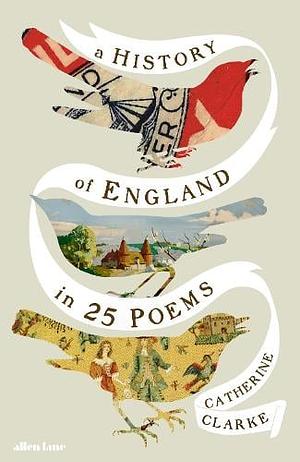
A History of England in 25 Poems
by Catherine Clarke
Genres: History, Non-fiction, PoetryPages: 400
Rating:

Synopsis:This is the history of England told in a new way: glimpsed through twenty-five remarkable poems written down between the eighth century and today, which connect us directly with the nation’s past, and the experiences, emotions and imaginations of those who lived it.
These poems open windows onto wildly different worlds – from the public to the intimate, from the witty to the savage, from the playful to the wistful. They take us onto battlefields, inside royal courts, down coal mines and below stairs in great houses. Their creators, witnesses to events from the Great Fire of London to the Miners’ Strike, range from the famous to the forgotten, yet each invites us into an immersive encounter with their own time.
A History of England in 25 Poems is a portal to the past; a constant companion, filled with vivid voices and surprising stories alongside familiar landmarks, and language that speaks in new ways on each reading. Catherine Clarke’s knowledge and passion take us inside the words and the moments they capture, with thoughtful insights, humour and new perspectives on how the nation has dreamed itself into existence – and who gets to tell England’s story.
Picking up Catherine Clarke’s A History of England in 25 Poems, I was interested but wary. I do love this kind of format for histories, because I think things like poems or fashions or household items and so on can all tell us an astonishing amount about the moments they were made and read, used, etc. But at the same time, “England” and “Englishness” is a bit of a tense concept: witness the English flags being tied to lamp posts and the varied reactions to them, the tensions around how to define Englishness and who belongs in England and — of course, inescapably for me — the tensions between England and other countries it’s ruled, subjugated, etc.
And Clarke handles this well, I think! She explicitly states that it is not a history of Britain, and occasionally calls out the tendency to conflate England with Britain as a geographical or political entity. She discusses the tensions between the Irish/Welsh/Scottish and England, and discusses that in terms of colonialism, because those countries were England’s first colonies. It’s surprisingly rare for someone to recognise that, especially for someone to recognise not just Ireland and Scotland’s issues with England but also the issues for Wales, and I appreciated it a lot. The book feels a bit less strong on the issues between England and the wider world, though it does discuss immigration, Windrush and the Partition of British India towards the end of the book.
The choices of poem are good: not just the canon (though at times it is, or canon-adjacent), and not just higher class voices or male voices. I learned about Mary Leapor, for example, a servant who wrote poetry that was essentially a parody of higher class “country house” poetry, in the same style but about life below-stairs. The poems aren’t all selected for artistic beauty or anything, which is important to know, and it isn’t a history of English poetry (some of the poets aren’t English) — it is a history (non-exhaustive) among many possible histories.
All in all, I would’ve preferred numbered footnotes, and perhaps a little more about the issues of England and colonialism, but I thought the 25 poems chosen did look through some interesting windows at snippets of history, some of which I didn’t already know well. I felt like I learned things, and had a good time; certainly I paused several times to write about the book enthusiastically on Litsy, and looked forward to reading more each time I put it down.
Rating: 5/5 (“loved it”)

Leave a Reply