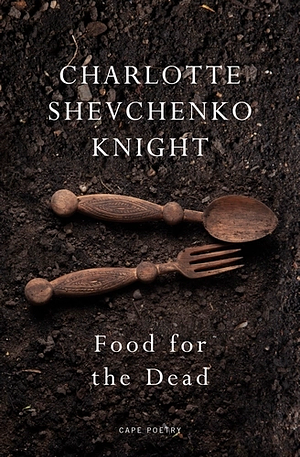
Food for the Dead
by Charlotte Shevchenko Knight
Genres: PoetryPages: 80
Rating:

Synopsis:With this searingly powerful first collection, Charlotte Shevchenko Knight gives the current war in Ukraine some much-needed human focus, while examining its brutal aggression within a wider and more accurate historical context.
Central to this book is ‘a timeline of hunger’, a lyric sequence which examines the legacy of the Holodomor (‘death by hunger’ in Ukrainian) – Stalin’s man-made famine of the 1930s. This long poem opens in Kyiv in 2021 – ‘brief visitations / of appetite / I devour / beetroot / its juices / running / down my lips / blood / of the past’ – and closes in Donetsk in 1929: ‘we burst the balloon / skin of tomatoes / between our teeth / seeds running down chins / like confetti / & we already know / every meal / should be celebrated.’ Through the poet’s sensitive approach to the historical, moving from that genocide of the early 1930s, then on through the Second World War, the Chornobyl disaster, to modern-day invaded Ukraine, we understand that within their ‘bones Holodomor / lives on’.
Both a howl of anguish and an eloquent counter-song against totalitarianism, this is a book about invasion, war, destruction and death, but also about the bonds of humanity, family and a history of oppression – about staying alive while always hungry.
Charlotte Shevchenko Knight’s Food for the Dead is a debut collection, as I understand it, and it’s full of poems reckoning with her family’s past, the past of Ukraine, and the legacy still marked in people’s bodies today — particularly the legacies of Holodomor (which are likely to have marked women on an epigenetic level, passing down vulnerabilities, as the Dutch hunger winter did).
It also discusses the way the Ukrainian language has been attacked, and defiantly sprinkles Ukrainian words throughout (introduced via a glossary which worked quite well in the ebook version, and then used without further definition in later poems). I thought this might annoy me more than it did, but at least in the ebook version it was pretty well done. In a print version, it’d probably work better with footnotes… but I’ve only seen the ebook version, and can’t comment on how it looks in print.
I didn’t love every single one of the poems here, but I enjoyed Shevchenko Knight’s imagery and use of language more often than not. The horrible hunger haunts the whole collection, and the reader.
I liked that for one poem there was a family picture as well, making it clear what it sprang from: a literal tree full of the poet’s family.
Rating: 4/5 (“really liked it”)

Leave a Reply