Tag: discussion

Discussion: Buying a Series

Posted September 3, 2018 by Nicky in General / 6 Comments

As with a lot of my discussion posts, this is basically prompted by authors posting on Twitter. In this case, authors are often to be found urging you not to wait for a series to be over before buying their books. There’s solid reasons for that, of course — if people don’t buy the first book in a series, publishers are probably not going to bother taking the risk of publishing the second book — let alone commit to an extended series in hopes that in ten years or so, once it’s complete, people will finally flock to buy the thing.

As a reader, though, I find authorial reproach on this topic… ugh, irritating isn’t the word, because it sounds unfair. But to me, it’s also unfair to expect readers to make an investment in a series right out of the gate, without it even being clear when the next books will come out, how long it’s going to take, how long the series might be, whether things are planned in advance… I would never bother to read the first book of a fantasy trilogy when it’s just the debut novel, for certain: I don’t want to be stuck in Scott Lynch-esque limbo. (I’m with Neil Gaiman — [author name] is not your bitch — but it’s been disappointing as a fan. And in that case, it wasn’t even after the debut novel that things slowed down. There were two books out in reasonably quick succession; it looked like a good bet!)

And of course, I don’t want to buy a book that I’m not going to read until I know when the next one is out. I have a backlog of over a thousand books; if nothing else, I don’t want to purchase something in order to have it sit there for five years inflating my counts and clogging my shelves.

Putting up a discussion post might imply I have an answer, but I really don’t. I don’t have a solid policy: I’ll buy a debut novel if it looks interesting, and I might even read it and risk spending five years waiting for the next book. But it’s something I really would like to balance out somehow: authors’ need for an audience, my desire to feel that I’m not gambling on the next book ever existing…

So hey, what do you guys do? Buy the first book and not read it? Buy the first book and read it and hope to goodness the next comes soon? Stubbornly hold out for the series’ end?

Tags: ,

Divider

Discussion: A Fast Read

Posted August 27, 2018 by Nicky in General / 4 Comments

I can’t remember which author it is, but there’s someone on Twitter who gets deeply offended whenever someone says, “Hey, I found your book a really fast read, totally unputdownable!” They completely take it as an insult, because they don’t want to be the kind of author who writes books that might be classed as easy to read.

Authors: please don’t do this. If I read your book fast, it is a compliment, and you’re just willfully taking offence if you decide that it isn’t. I’m a fast reader anyway, and it doesn’t mean that I don’t take in what I’m reading or appreciate your subtleties. How fast I read a book is much less important than how long it stays with me afterwards: there are books which take me months to read and feel like a total chore — do you really want to be one of those?! Because if your book is one of those, I can almost guarantee you… I don’t like it that much.

(There are some exceptions, mood reading and such. But in general…)

Now, there is a time and a place for close-reading. 1) A literature degree, 2) understanding how something is put together because it’s just that fascinating, and 3) you enjoy doing it. I’ve done close-reading for all three reasons — it’s not an impossible thing to hope that someone might do at some point — but most readers aren’t interested in doing that, and most of us just read at our own speed, and savour the book (or not) in our own way.

It’s a compliment, I swear. Chill.

Tags: ,

Divider

Discussion: Half Stars

Posted August 20, 2018 by Nicky in General / 8 Comments

It’s come up a couple of times lately when I’ve rated a book — I experience a fleeting wish for half stars. I used to be pretty active in the Goodreads Feedback Group, and that was perennial plea: give us half stars! And I don’t really actually get it, most of the time, if I’m honest. I mean, the Goodreads rating system goes like this:

5 stars: it was amazing
4 stars: I really liked it
3 stars: I liked it
2 stars: it was OK
1 star: terrible

I can’t remember if that’s the exact wording or not, but you get the gist. Now I don’t really see how that leaves room for intermediates (unless you’re just not using the scale at all, but then you can do whatever you like anyway and state that you’re awarding half stars in your review). Making it more granular makes it harder to decide, for me at least — and yet the cry was always, “well, I need half stars because I can’t decide between four and five!” To me, I don’t see how that helps: now you have more stars and they have ambiguous meanings (“I half really liked it!”) and surely that could lead to infinite regression. Quarter stars, eighth stars, sixteenth stars…

Nah, I’ll stick to full stars. If I was rating something to suggest whether a publisher should pick it up, maybe there’d be more need for precision. But it’s not like the ratings are actually precise anyway: how many times can you say you liked two books exactly the same?

I just don’t get it, I guess. A simple five star scale is enough for me in terms of giving a sense of where I am on the continuum — and having the stars weighted towards the positive end makes sense, too, because it’s not as important to know how much someone disliked a book as how much someone liked a book.

Probably this is all just me, but hey, now you know why I don’t use half-stars and rarely talk about wanting to use them: if I do, I really am on the fence, and usually it’s because I think a book deserves a higher score for technical merit, but I didn’t like it. (And all my star ratings are based on liking, so giving some things four stars is just lying, no matter how technically brilliant I think they are.)

So how do you rate books? Do you have a system, or do you go with your gut?

And hey, happy birthday to me!

Tags: ,

Divider

Discussion: Who are reviews for?

Posted August 13, 2018 by Nicky in General / 11 Comments

I saw this on Twitter (this thread) and immediately had a ton of thoughts, especially after I saw the tweet claiming that reviews (in general) are for everyone: authors, readers, other reviewers… And in one way, that’s true; there’s no way I can stop authors coming to my blog and reading my reviews, and maybe they’ll be useful to authors too! I don’t begrudge them to authors, if they’ve got thick skins and can keep themselves from arguing with me.

But. With every piece of writing, you have an audience in mind. That’s part of what makes the writing effective: you tailor it to the people you want it to be useful to. It’s no use me posting here talking about the MIC of bedaquiline against Mycobacterium tuberculosis — you’re a smart bunch, so I’m sure some of you know what the MIC is and what it’s about, but it’s simply not relevant to most people — and likewise there’s no point in me using a chatty style in my dissertation. The audience distinction between other readers and the author of the thing being reviewed is not necessarily that large, but I’m definitely not keeping the author in mind when I review. I’m talking about what I liked and what I didn’t, and often don’t even touch on anything beyond personal taste. Now, unless an author’s planning to write a book just for me, that’s not exactly useful, is it?

Now, reading the actual thread, I don’t think me and the writer of that thread are actually too far apart in our opinions. I don’t disagree that reviews are open to and worth scrutinising, etc, etc. But all the same, I have an audience in mind for my reviews and it’s not authors (and it’s not really non-readers, either: I don’t see why a non-reader would be interested in my reviews). So sure, my reviews can be read by anyone who comes along and maybe they’ll be of interest or even useful for people whom I don’t expect to find them so.

But still, saying my reviews are for anybody I don’t think they’re for is putting a bit much of a burden on the rather slender shoulders of my typically 200-word-ish summaries of what I thought of a book. And I don’t think most people who are saying that reviews aren’t for authors or aren’t for xyz are saying that their reviews can’t/shouldn’t/mustn’t be read by those people — they’re saying, fucking Christ, will authors please stop commenting on my reviews to browbeat me because I didn’t like their book. So in that sense, yeah. Reviews are for other readers. Fight me.

(Please don’t.)

Tags: ,

Divider

Discussion: Rites of the Reader

Posted August 6, 2018 by Nicky in General / 6 Comments

Because I love my puns.

I don’t know about other people, but over time I’ve had quite a few different quirks and rituals about reading (hi, my name is Nikki, I have obsessive-compulsive tendencies). When I was a kid, I actually used to read sitting on the staircase (I don’t know why) and so the ritual was to move down a step with every chapter finished. I got through many a Famous Five book that way. The only hitch was that I couldn’t leave the stairs until I’d finished a book. That could be… awkward.

I also had a thing where I couldn’t stop on an odd-numbered chapter, or in the middle of a page. (But for some reason, it was okay to stop at the end of the first paragraph on the page, as long as it was a continuation from the previous page, and not a new paragraph.) And then there was the thing with putting bookmarks ahead of myself in the book, and then I couldn’t stop until I got to them.

I’m mostly over all of those now, actually. I do still prefer to finish a chapter, but I can be pulled away from my book when necessary. I do like putting a bookmark ahead of myself to mark a stopping point or something that I want to get to. My main rituals surrounding reading now, though, are “bookbed” — me and my wife go to bed early to read — and the fact that I inevitably can’t sleep when she does, and so normally stay awake long into the night reading! I can’t really think of anything else.

So what’re your little quirks — the things you have to do when reading, or your ways of storing books, or… anything like that?

Tags: ,

Divider

Discussion: The Rights of the Reader

Posted July 30, 2018 by Nicky in General / 6 Comments

I’m fairly sure a lot of people have heard of Daniel Pennac’s book, The Rights of the Reader, maybe without knowing quite where it comes from (since the book itself is originally in French). Quentin Blake’s illustrations help with that, given the posters of the rights plus his illustrations that you can get, and I know I have seen those around.

Anyway, if you’re curious you can read my review of the book here, which is mostly about getting kids reading instead of the rules’ general applicability, but this post is actually about the rights themselves. And here they are, illustrated by Quentin Blake (click to embiggen):

  1. The right not to read.
    Seems like good sense to me. Who wants to feel forced to read? There are some situations where I guess you do have to read the book, like literature classes. Even there, I think there should be room for wriggling. I did a crime fiction course at Cardiff University, and one of the books included was a transphobic, rapey mess with tortures lovingly described in practically every chapter. I did feel that maybe we should’ve at least been given some warning about that one.
    Also, you know that feeling where everyone’s been reading a book so you should hurry up and do it too? Yeah, I think this right covers that, too. Read what you want to, when you want to. In other words, Mum, I’ll read Republic of Thieves when I’m good and ready.
  2. The right to skip.
    Read the ending first? Skip a gross scene or a boring chapter? Skip ahead to your favourite bit? All good with me, I’m all for this right.
  3. The right not to finish a book.
    I know a lot of people don’t like not finishing a book, but I’m all for it — I’ve already done a discussion post about it. Again, I just don’t see the point in feeling forced to read something you’re not enjoying. Unless you’re sort of masochistic about books, I guess. Actually, Quentin Blake’s illustration looks like he’s thinking that means just waiting to finish a book you’re enjoying, and hey, that’s valid too.
  4. The right to read it again.
    Something I’m clearly for, if you hang around here at all. Again, I have a whole post on it.
  5. The right to read anything.
    Screw the idea of guilty pleasures or feeling weird because the book’s actually aimed at middle grade readers or whatever. Read for pure joy and if it makes you happy, that’s great.
  6. The right to mistake a book for real life. 
    “It me!” Also referred to in the book as “Bovary-ism”. Because who doesn’t want to imagine they’re an interdimensional Librarian? Honestly, I’m not entirely sure what this one is meant to mean anymore, but if it means getting so caught up in a book it matters more than whatever else is on your plate, I’ve been there and done that and those are some of the absolute best books.
  7. The right to read anywhere.
    Okay, don’t do anything dangerous, but if you want to read sitting in the kitchen sink (high five if you know that reference) or while walking (with a careful eye on traffic) to work, then more power to you. I’ve read in bed, on trains, on planes, sitting on the stairs, sitting on a wall, sitting in the hall… and I’ve no doubt the list will keep growing.
  8. The right to dip in.
    Sounds a bit like the right to skip, to me. Actually, I’m kind of against this one for myself — I start at the beginning and go on until I come to the end, or give up. But hey, if you like reading random chapters or the middle book of a series, why not?
  9. The right to read out loud.
    I actually like to whisper the words to myself as I read. It’s not like I read to, and I read faster silently, but I love the shape and taste of words, and I kinda hate that I have to give that up in public for fear of being weird. (Also when my sister is in the room, because the whispers annoy her.)
  10. The right to be quiet.
    Nobody should disturb you when you’re reading.

I can think of some other ones, some more silly than others — the right to fill a book with bookmarks at strategic points while I’m reading so I can track my progress. The right to babble to others about the exciting thing I’m reading. The right to give other people books you think they’ll love. The right to differ from other people about a book (I’m sorry, I just don’t get some authors).

But really, it all comes down to one golden rule, which if you read my blog you can probably guess. Everyone deserves…

THE RIGHT TO ENJOY THE HECK OUT OF READING BY WHATEVER MEANS NECESSARY FOR THEM.

Tags: ,

Divider

Discussion: Rereading

Posted July 23, 2018 by Nicky in General / 14 Comments

I’ve probably written about rereading books here before, but it bears talking about again. I can’t understand the people who feel it’s a waste of time — it seems like hubris, to imagine that for every book you read, you get absolutely everything out of it on the first try and never need to read it again. I’m an English Literature grad, and I wouldn’t claim that — and in my Natural Sciences degree, I wouldn’t presume to think I understood most papers until a third or fourth reading, though granted they tend to be technical.

I mean, that’s the fancy excuse for rereading: I want to get everything I can out of it. (And for some books that’s definitely true: I’m still getting new stuff out of The Lord of the Rings and The Dark is Rising to chew over now, and I don’t know how many times I’ve read them.) It’s a good reason, but honestly, I don’t want it to eclipse the real reason I might reread a book: because I feel like it. Because I want to revisit that world. Because it was just that good the first time and I want to re-experience it. Because I need to refresh my mind before I read the sequel.

I mean, if you don’t enjoy rereading, then that’s one thing — but if it’s just because there’s so many books and so little time, well, that’s going to be true whether you reread or not. If you feel like rereading, why not? Again it comes down to the principle I keep reminding myself of: I read for fun. I don’t read to hold the record of the most unique books read in a single lifetime, or have an impressive list of all the classics checked off. What’s the point?

There is a flipside: you can read a book until it’s too predictable, too worn through in your mind. The best books can survive this, but even a good book can get a bit threadbare. (Good Omens, I’m looking at you.) But then it’s not so fun anymore, so the fun principle still holds.

So yeah. For my money, go reread books until your physical copies are floppy and faded with age and they fall open on your favourite bits. Talk about books you’ve reread until people are sick of hearing about it (I won’t get sick of hearing about it). Take any excuse if rereading is something you enjoy. You don’t owe those other books a thing.

Tags: ,

Divider

Discussion: Book Fandom Friends

Posted July 16, 2018 by Nicky in General / 10 Comments

This week’s topic is about the friends we make through our blogs! Or really, the fact that we don’t know too much about each other sometimes — I feel like I know some of your tastes so well and know exactly where we dovetail in terms of what we each enjoy, but I don’t know where you’re from or whether you’re married or what you do for a living or… Sometimes, it feels like I know you so well on the level of how you respond to books, it’s a shock to realise I have no idea if you have siblings or whether you live in Montana or on the moon.

So! Here is a basic profile of some things that are important about me; does any of it surprise you? What would you like to share with me in return? (Don’t feel obligated to share the same stuff — whatever you want to reveal.)

Name: Nikki
Age: 28
Birthday: 20th August
Location: Leuven, Belgium, but only for another 15 days
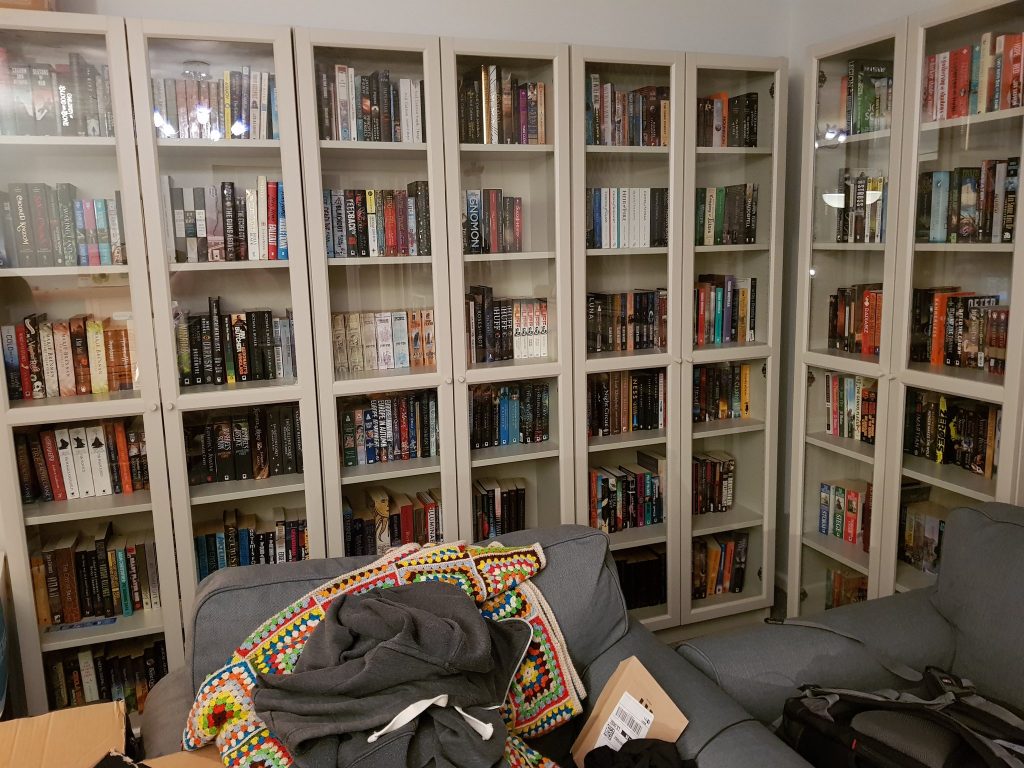
Living with: Wife and six bookcases
Siblings: One sister, one dude I adopted as my brother because we needed to stick together
Marital status: Thank god she reads books too
Pets: Two rabbits, Breakfast and Hulk
Job: Freelance transcription and website support; just finishing up a full time degree (my third!) in biology
Ebook or dead tree: Both, either, depends on my mood
Night owl or morning lark: Night owl
Favourite bookshop: The American Book Center in Amsterdam
Favourite animals: Hippos, giraffes, and now rabbits
Other hobbies: Doing degrees, playing video games, crocheting, buying more books to read

That’s all a bit daft and probably doesn’t help, so hey, ask me anything you want to know! I might even answer. I love our community; let’s make it a little bit closer yet (even though I feel like I know enough about you to know we’ll get along if I know your taste in books). <3

And hey, how do you feel about the whole blog thing? Do you feel like you get to know people through their books? Do you sometimes wish you knew other folks better? Or are the books enough?

Tags:

Divider

Discussion: Diversity

Posted July 9, 2018 by Nicky in General / 6 Comments

I have this as a prompt in my list of potential discussions — just “diversity”. You all probably know what I mean, given it’s so often talked about in book fandom these days: characters of all types of backgrounds, in terms of culture, in terms of gender, in terms of sexuality, in terms of disability… Basically, there’s been a huge drive in the last few years to encourage books that aren’t just about white men, and books which aren’t just by white men. And I think some people struggle a lot with this and feel like it’s gone “too far”.

One example people have of things going “too far” is when the majority of characters in a book are queer. But queer people are only meant to be a small percentage of the population! someone inevitably cries. Sure, but if you look at queer people in real life… we stick together. I know queer people just because they’re queer and so am I, and it’s not just about the pool of people available for me to date. Queer people often make friends with other queer people because we share experiences that straight people don’t. So it just makes sense that a queer character would surround themselves with other queer characters.

(Also, hey, queer people are people, with the same drives and motivations as everyone else. You’re not reading about an alien with unfathomable motives: what difference does it make if most of the characters don’t share your sexual orientation? If you’re straight, you’re hardly suffering for representation in fiction — you can just pick up another book instead!)

Another worry about diversity is when people not belonging to a certain minority co-opt parts of that experience to write about it or weave a world around it or whatever. I’m not saying it can never be done well, though I’d shy away from doing it myself if I were still writing, because you should respect that experience and do a ton of research to make it right. There’s not a lot of representation of this stuff out there, historically, so adding any is bound to make an impact. Even with all the research in the world, I’d have to ask myself if I was really the best person to write about it.

And of course there’s when people not belonging to a culture outright exoticise it. I mean, there’s a certain amount of the appeal of a different culture that’s always going to be about the exotic, whether it’s actually aliens or just a culture people aren’t too familiar with. But there are right and wrong ways to handle that, when it comes to real cultures, and research is the better part of valour 100% of the time when that’s what you’re doing.

Diversity isn’t easy — it doesn’t come just because you added a couple of black people to your fantasy school body or have a Chinese scientist on your crack team of experts. It also doesn’t have to be about flipping things round and making the minority the dominant group. Reality is diverse (and if yours isn’t, maybe it’s time to consider why)… it’s only right for fiction to follow suit.

Tags: ,

Divider

Discussion: Deciding what to read

Posted July 2, 2018 by Nicky in General / 10 Comments

With such a massive reading list, sometimes I end up spoiled for choice. There’s a gazillion and one books I want to read at once, so how do I choose?

Welp, I’ve found that any kind of constraint tends to just make me contrary. Have to review it by next week because it releases soon? Let me ignore it altogether for at least another month. Planned to read it for a readalong? Often, that just leads to meh as well. In the end, I’ve come to terms with this — I had a really great conversation over on Beeminder’s forum about my attitude to books and goals in general a few weeks ago, which really helped elucidate that I was making it into work, and it really doesn’t need to be.

So yeah, you’ll find that I might miss review deadlines by a mile, but review something that’s been out for five years the day after I got it. Or vice versa. In the end, it comes back to something I’ve said on here a couple of times: this isn’t my job. I do this for fun. This may not always be a winning strategy with publishers (ugh, my Netgalley ratio is appalling) but it works for my brain and keeps the dreaded reading slumps mostly out of my way.

So what’s your strategy? Reading lists, never own so many books you have to make choices, whatever’s got a deadline on it…? And how on earth do you stick to it when there’s such new shinies out there?!

Tags: ,

Divider