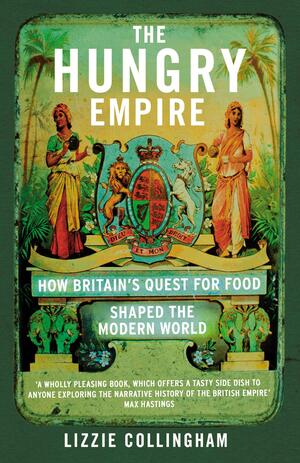
The Hungry Empire: How Britain's Quest for Food Shaped the Modern World
by Lizzie Collingham
Genres: History, Non-fictionPages: 367
Rating:

Synopsis:The glamorous daughter of an African chief shares a pineapple with a slave trader ... Surveyors in British Columbia eat tinned Australian rabbit ... Diamond prospectors in Guyana prepare an iguana curry ... In twenty meals The Hungry Empire tells the story of how the British created a global network of commerce and trade in foodstuffs that moved people and plants from one continent to another, re-shaping landscapes and culinary tastes. To be British was to eat the world. The Empire allowed Britain to harness the globe's edible resources from cod fish and salt beef to spices, tea and sugar. By the twentieth century the wheat to make the working man's loaf of bread was supplied by Canada and his Sunday leg of lamb had been fattened on New Zealand's grasslands. Lizzie Collingham takes us on a wide-ranging culinary journey, charting the rise of sugar to its dominant position in our diets and locating the origins of the food industry in the imperial trade in provisions. Her innovative approach brings a fresh perspective to the making of the Empire, uncovering its decisive role in the shaping of the modern diet and revealing how virtually every meal we eat still contains a taste of empire.
Lizzie Collingham’s The Hungry Empire takes two different tacks in addressing the subtitle, “How Britain’s Quest for Food Shaped the Modern World”. One is to discuss the food the British Empire imported to Britain, the adoption of new spices, of sugar, of tea — a fairly well-worn story, but nonetheless part of understanding imperialist expansion, and sometimes even the explicit cause of it.
The other is to discuss the less intentional way that food travelled with immigrants and slaves, especially the slaves, or was shipped around the world to cope with the needs of slaves and indentured people, and how these diets affected health. The latter part was a bit more interesting to me because I’d read less about it elsewhere. As a note, it’s fairly dispassionate about all this, rather than outraged at the casual treatment of people as chattel; it does comment about stuff like horrible conditions on slave ships and the high mortality rates, but it mostly just gives the facts… aside from when discussing opium and China, at which point it gets very defensive about Britain’s role in that and argues that the impact of opium on China is over-exaggerated. It’s hard to say how to take that without more context.
I did find the book fairly slow/long-winded, personally; there was something about the author’s writing that I really couldn’t keep my attention on for long, unfortunately. I found the inclusion of the recipes an interesting idea but intrusive — they aren’t always positioned at the ends of chapters, and sometimes just break in mid-paragraph. Weird choice.
It’s an interesting book and I am glad I read it, but it was definitely slow-going.
Rating: 2/5 (“it was okay”)